ChatGPT
 Grok
Grok
 Perplexity AI
ChatGPT
Grok
Perplexity AI
Perplexity AI
ChatGPT
Grok
Perplexity AI
4 min read | By Muhammed Irbaz | 02 July 2026 | Mobile app development
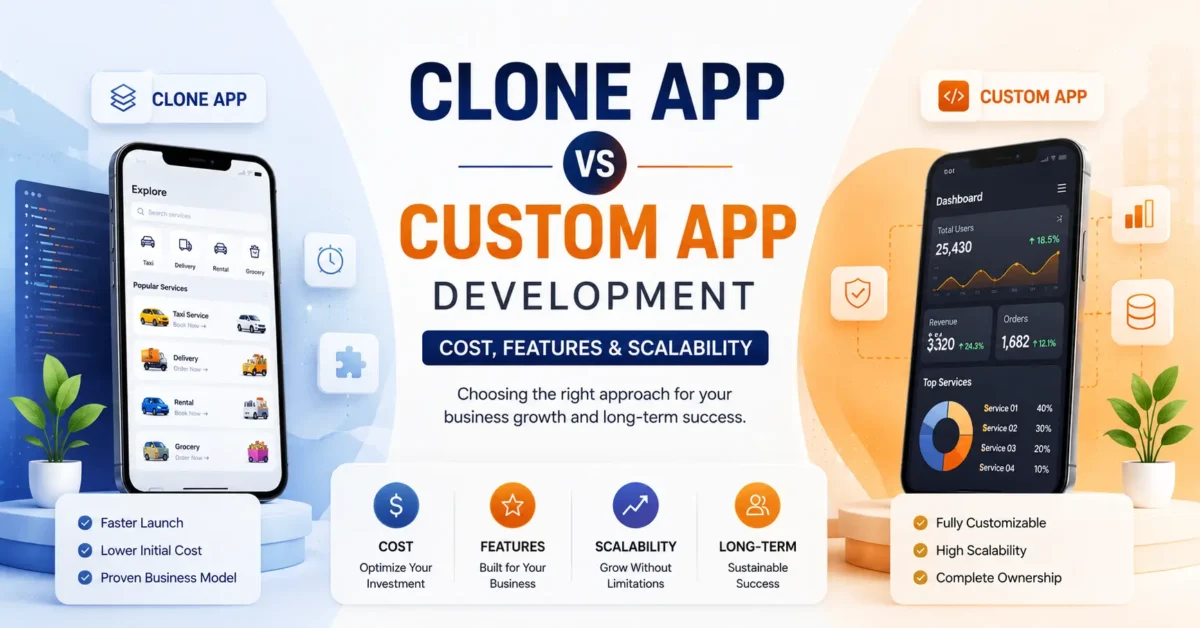
Choosing between clone app development and custom app development is one of the most important decisions for businesses launching a digital product. While clone apps offer a faster, lower-cost way to enter the market using proven features, custom apps provide complete flexibility, stronger scalability, and long-term competitive advantages.
● Clone apps cost less upfront, but heavy customization closes that price gap faster than most expected.
● Most clone-based products hit architectural limits sooner than expected.
● Launching earlier with a clone means capturing early adopters and generating revenue before the competition ships.
● Start with a clone, validate with real users, then invest in a custom build once the market confirms the idea.
Source: grandviewresearch
Most businesses land on a clone app because the numbers and the timeline make it hard to argue otherwise. The calculation shifts, though, when growth targets get serious, when the brand needs its own identity, and when the product has to hold up at scale that is when custom app development starts making more financial sense.
Startups working with limited runway think about this differently than enterprises with dedicated product teams, and neither of them is wrong. What makes clone app vs custom app development tricky is that the answer keeps changing depending on what stage the business is at, what the cash position looks like, and how much runway exists before the product needs to show results.
This guide covers the real cost numbers, feature limitations, scalability differences, and a practical decision framework everything needed before committing to either path.
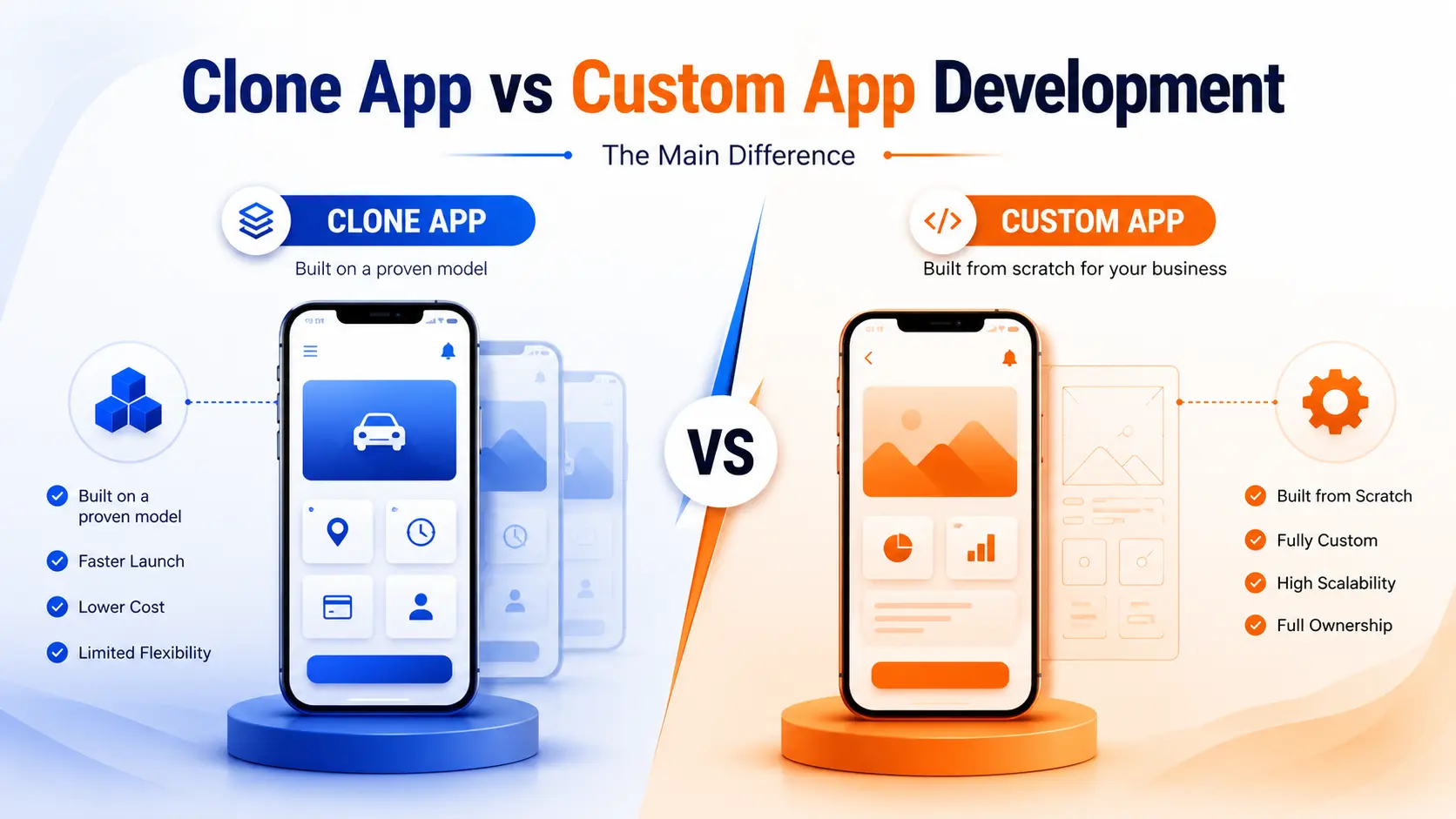
Clone app development builds on an existing proven product model. Custom app development builds an entirely original product from the ground up. The core difference lies in ownership, scalability, and how far the product can grow.
Clone app development takes a business model that already has traction and rebuilds it for a new context. Taxi apps following Uber’s structure, rental platforms modeled after Airbnb, online stores built around Amazon’s framework are the kinds of ready-made app solutions that skip the early guesswork. The hard product decisions have already been made somewhere else; what remains is shaping the existing structure to fit a different brand and market.
Custom app development works the opposite way there is no existing codebase to lean on. The architecture, the tech stack, the feature logic, and the entire web application development process are decisions made from zero, built specifically around what that business needs. That is what makes it slower and more expensive upfront, and also what makes it the only viable option when the product idea has no direct market equivalent.
| Factor | Clone App Development | Custom App Development | What It Means in Real Terms |
|---|---|---|---|
| Base framework | Pre-built | Built from scratch | Clone apps reuse existing code. Custom apps are written fresh for that business alone. |
| Time to Market | Faster (weeks) | Slower (months) | Clone apps launch in 4–8 weeks. Custom apps take 4–12 months. |
| Investment | Lighter upfront | Bigger commitment | Clone apps require less to get started. Custom apps need a larger investment from day one. |
| Uniqueness | Limited | Fully unique | Clone apps resemble their source. Custom apps are built to stand apart. |
| Scalability | Moderate | High | Clone apps hit a growth ceiling. Custom apps are built to scale without limits. |
| Flexibility | Low to Medium | Very High | Clone apps are harder to modify. Custom apps can evolve anytime without major risks. |
| Ownership | Shared / Licensed | Full ownership | Clone code is shared across clients. Custom apps are fully owned by the business. |
| Maintenance | Simpler initially | Requires dedicated support | Clone apps are easier early on. Custom apps need a dedicated team long term. |
| Security | Standard level | Custom-built security | Clone apps offer basic protection. Custom apps are built to specific compliance needs. |
| Best For | Fast launch, proven markets | Unique ideas, long-term growth | Clone apps suit quick market entry. Custom apps fit growth-focused businesses with a unique vision. |
Clone app development generally requires a much lighter investment than building a fully custom product.
An existing framework cuts out a significant chunk of the groundwork, the design decisions, the architectural planning, and the core engineering hours. That reduction in effort is the direct reason clone app development cost lands lower than what a fully original product requires.
Reused infrastructure keeps clone app investment down but that changes quickly when heavy modifications enter the picture. Businesses that need significant changes to the base product often find the cost difference between clone and custom app shrinking to a point where the custom route starts looking like the more practical option.
On the clone side, costs rise when the business needs heavy UI changes, additional third-party integrations not included in the base, or compliance features that the original framework was not built to handle.
Key cost drivers worth factoring in:
● Feature complexity and depth of integrations
● UI/UX design requirements – branding, user flows, visual systems
● Backend infrastructure and database architecture
● Security, compliance, and data privacy standards
● Post-launch maintenance and support contracts
Custom app development offers better features and scalability. Clone apps handle the basics well, but as a business grows, custom apps are the only ones genuinely built to keep up.
Comparing clone vs custom development on features and scalability is not a straight line where the business currently sits, and what the next three to five years demand, changes the answer considerably.
Feature Depth: Clone apps handle standard functionalities reliably. An ecommerce app development project built on a clone model will typically include product listings, cart management, payment gateway integration, and order tracking. A custom-built platform, by contrast, can incorporate real-time analytics engines, AI-driven pricing models, role-based dashboards, and deeply integrated third-party logistics tools capabilities that a clone framework simply cannot support without a near-complete rebuild. But when a business needs AI-powered recommendations, hyper-personalized dashboards, or proprietary algorithms, a clone almost always falls short and faster than expected
Scalable App Development: Scalability is where custom apps genuinely shine. Custom-built systems are designed with growth in mind; the architecture accommodates expanding user bases, new feature additions, and third-party integrations without requiring a full rebuild. Clone apps, while functional at a smaller scale, often hit architectural limits as traffic and feature demand increase.
Businesses pursuing marketplace app development with multiple vendors, complex commission structures, and dynamic catalog management often find clone solutions becoming restrictive much sooner than expected after launch.
The benefits of custom app development over clone apps become more apparent as the business scales, the user base grows, and the need for proprietary features intensifies what felt like a minor limitation at launch turns into a full architectural problem at scale.
| Criteria | Clone App | Custom App |
|---|---|---|
| Core Features | Ready out-of-the-box | Fully tailored |
| Advanced Features | Limited / Add-on cost | Unlimited possibilities |
| Scalability | Moderate ceiling | Enterprise-grade |
| Performance | Standard | Optimized |
| Third-party Integration | Pre-defined options | Any integration possible |
Building from scratch makes more sense when the product idea is genuinely unique and long-term ownership matters. A clone app makes more sense when speed, budget, and a proven market model are the priority.
Clone app vs building from scratch is rarely just a technology decision, market timing, competitive windows, and how defensible the product idea is all carry equal or greater weight than the tech stack itself.
Choosing to build from scratch means committing to a full custom software development process where every decision belongs to the business.From the tech stack and security protocols to the product roadmap and core architecture nothing is borrowed, nothing is shared. This is the preferred path for businesses targeting a unique niche, building a differentiated user experience, or planning to hold long-term ownership over their product and intellectual property.
App clone development, on the other hand, tends to work well for:
● Entrepreneurs validating a new market or concept quickly
● Businesses that need an MVP app development approach before committing to a full custom build
● Teams working within tight initial budgets but with strong revenue projections
● Industries where the proven model already exists and differentiation comes through service quality not technology
Clone app development vs building from scratch loses its clarity when the product idea is genuinely novel. If no comparable app exists, cloning is not even an option; custom development becomes the only viable path. That said, launching three months earlier with a clone can mean capturing early adopters, building a user base, and generating revenue that funds the next development phase.
The honest answer is that neither path is universally better; the right one depends entirely on whether the business is entering a proven market or creating a new one.
Choose a clone app when speed is the priority. Choose custom app development when the goal is a distinctive product, full ownership, and long-term scalability.
Making the right choice requires honest answers to a few critical questions about the business, its goals, and available resources. Partnering with an experienced mobile app development company can help teams evaluate these factors clearly and without bias.
| Business Scenario | Recommended Approach |
|---|---|
| Limited budget, fast launch needed | Clone App Development |
| Unique product idea with no market equivalent | Custom App Development |
| Testing market viability (MVP stage) | Clone App or White Label |
| Long-term scalability is a top priority | Custom App Development |
| Brand differentiation is core to the strategy | Custom App Development |
| Quick entry into a proven market (ride-share, food delivery) | Clone App Development |
For businesses sitting somewhere in the middle, white label app development is worth serious consideration. These are pre-built platforms that can be rebranded and lightly customized landing between a clone and a fully custom product in terms of both cost and flexibility, without the full commitment either direction demands.
The development approach does not have to be permanent; many businesses start with a clone, validate the market, and migrate to a custom build once the revenue justifies it. The key is aligning the development approach with the specific business phase, not just the available budget.
Starting lean with a clone and planning a custom rebuild later is a valid and increasingly common strategy among growth-stage businesses. The core question every founder must ask is this: should a business build a clone app or custom app based on where things stand today, not just where things are headed tomorrow.
Businesses ready to take the next step can hire a professional to evaluate the right approach based on budget, timeline, and long-term growth goals.
The right choice between clone app vs custom app development comes down to budget, timeline, how unique the product idea actually is, and how serious the scalability ambitions are. Clone apps offer speed and lower entry costs. Custom apps offer depth, differentiation, and room to grow without hitting walls.
Businesses that tend to get this right rarely treat it as a single decision; they treat it as a sequence. Ship fast with a clone or MVP, collect feedback from people actually using the product, then put serious money into a custom build once the market has confirmed the idea has legs and the revenue can support the investment.
Yes clone apps generally require a much lighter investment than custom development.
Clone apps handle early growth but hit architectural limits sooner than most expect.
Basic branding changes are possible, but deep customization gets expensive fast. At that point, the cost difference between clone and custom app development becomes surprisingly small.
Startups validating an idea on a tight budget are better off starting with a clone or MVP. Once the market confirms the concept, moving to a custom build makes far more sense.
Clone apps lack flexibility for proprietary features, unique experiences, and advanced integrations. Any genuinely original product idea will quickly hit walls a clone framework was never built to handle.
When the product needs unique features, full IP ownership, and long-term scalability, custom development justifies the higher upfront cost. Businesses planning serious growth almost always recover that investment through fewer rebuilds.
Join over 150,000+ subscribers who get our best digital insights, strategies and tips delivered straight to their inbox.