ChatGPT
 Grok
 Perplexity AI
ChatGPT
Grok
Perplexity AI
4 min read | By Muhammed Irbaz | 22 October 2026 | Software Development
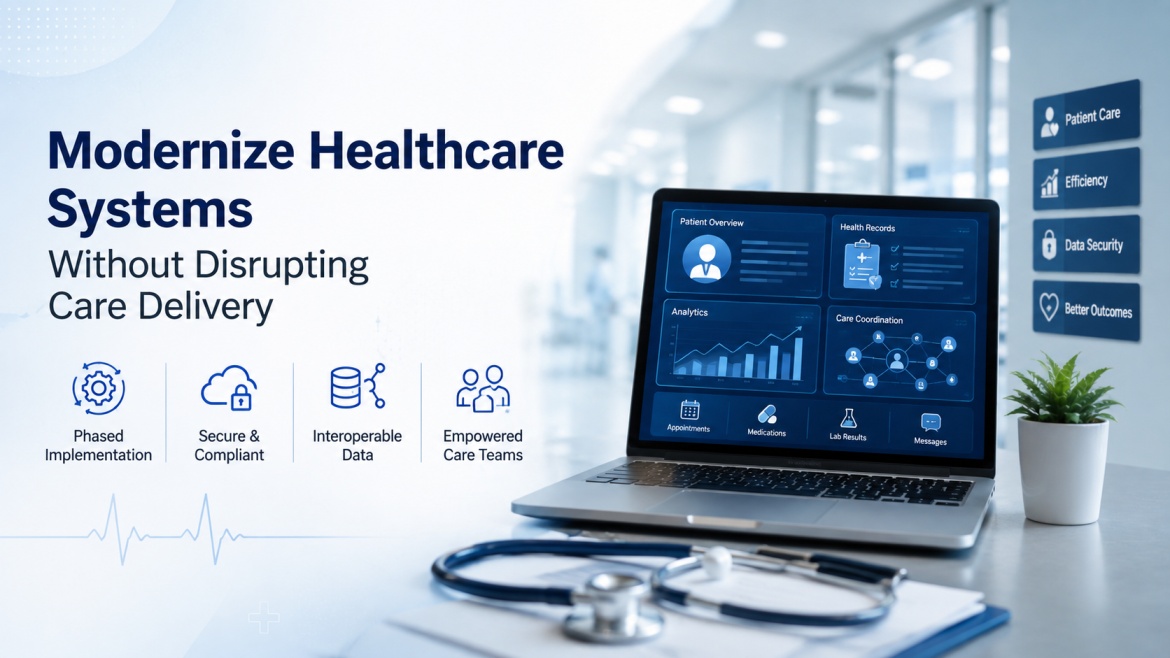
Healthcare organizations can upgrade their systems without interrupting care by phasing rollouts, strengthening interoperability, and adopting AI gradually. This protects continuity of care while outdated infrastructure gets replaced at a manageable pace.
The healthcare information system market stood at USD 773.9 billion in 2025 and is on track to climb from USD 892.8 billion in 2026 to USD 2,660.2 billion by 2033, growing at a CAGR of 16.9% over that period.
Source: GrandViewResearch
The technical upgrade is rarely the hardest part of healthcare modernization. What’s hard is making sure that upgrade doesn’t spill over into the clinical and administrative work patients and staff count on every single day.
Healthcare digital transformation is the integration of digital tools, cloud platforms, automation, and data-driven decisions into clinical and administrative operations. It improves patient outcomes, staff efficiency, and organizational agility.
This kind of shift goes beyond swapping old software for new. It’s about restructuring how information moves through a hospital, cutting administrative drag, and building resilience against disruption. In practice, hospital digital transformation usually starts small, testing digital tools in lower-risk administrative areas before those systems ever touch core clinical workflows, once staff readiness and governance frameworks are in place.
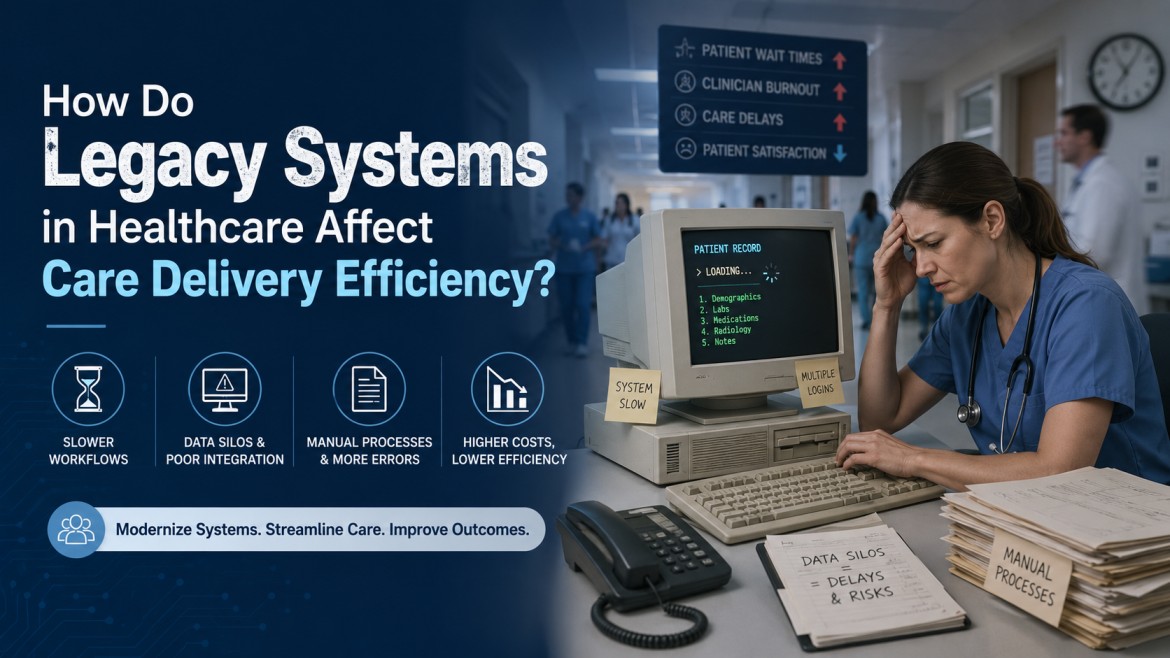
Traditional healthcare infrastructure relies on siloed records and manual processes that can’t keep up with today’s data volume or digital health pace. This creates bottlenecks, errors, and compliance risks that modernization directly resolves.
Walk into a lot of hospitals today, and much of the core infrastructure is decades old: siloed records, stacks of manual paperwork, processes built for a much smaller and slower era. None of it was designed for the volume of data generated today, let alone the speed at which digital health tools now operate. Bottlenecks pile up. Errors creep in more easily. Scaling services or reacting fast to new regulations becomes a genuine struggle.
These changes show up clearly when comparing traditional and modernized systems side by side.
| Traditional System | Modernized System |
|---|---|
| Paper-based or siloed records | Centralized, interoperable digital records |
| Manual scheduling and billing | Automated scheduling and billing workflows |
| Reactive maintenance | Proactive, cloud-based monitoring |
| Limited data visibility | Real-time, unified data access |
| Slow regulatory reporting | Streamlined compliance reporting |
Healthcare systems modernize without disrupting patient care through phased implementation, early infrastructure assessment, and staff training before rollout. Compliance and security stay built in throughout the transition, not added afterward.
Modernizing healthcare without disrupting patient care starts with knowing exactly what can move now and what needs more runway before it’s touched.
Before anything gets swapped out, it helps to take a hard look at what’s actually there: which systems truly need replacing, which can transition gradually, and which are fine staying put a while longer. Attempting a full overhaul at once significantly increases operational risk. That’s why the healthcare IT modernization projects that actually succeed tend to start small, lower-risk administrative systems first, before anyone touches anything tied directly to clinical care.
Merging legacy systems with newer platforms is a delicate process with little margin for error.
Patient records, billing histories, clinical documentation- none of that can afford to get lost or mangled along the way. Electronic health records integration is usually the trickiest part of the whole process, since clinicians are pulling up patient history in real time and any gap there has real consequences.
Good system integration is what keeps all of this connected once the migration itself is done. Beyond the technical side, staff training and clear communication matter just as much, maybe more. People push back less when they understand why something’s changing and have a realistic timeline to work with. For organizations that don’t have the bandwidth for this kind of complexity in-house, legacy system modernization services often fill that gap, and integrating legacy healthcare systems this way tends to go a lot smoother.
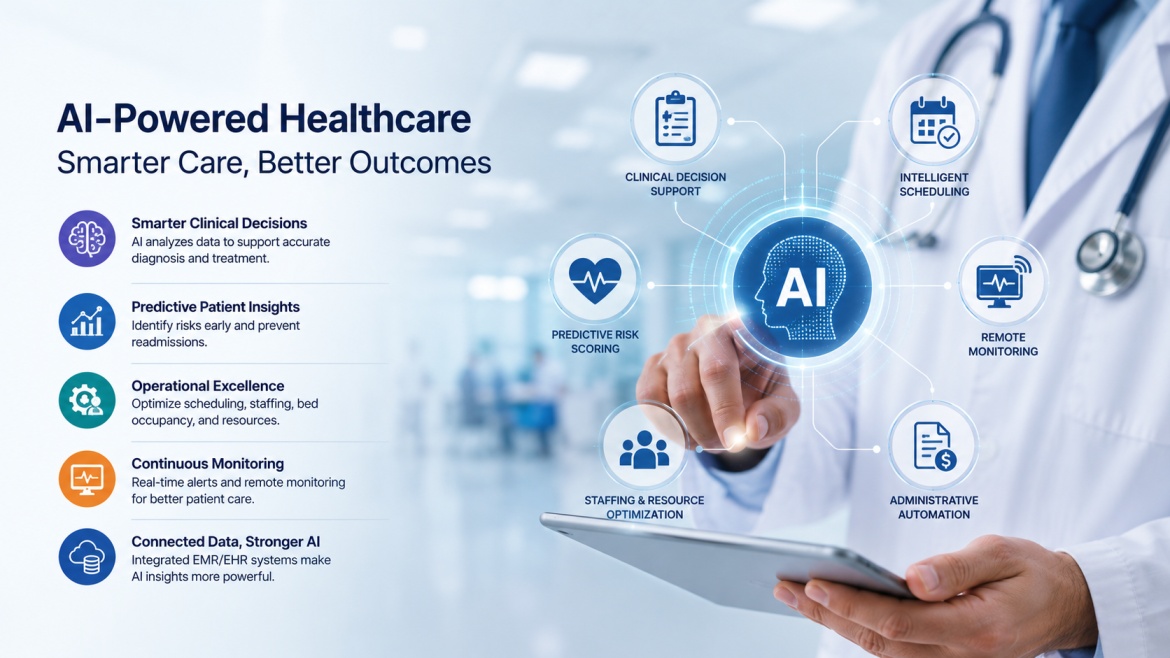
The growing role of AI in healthcare reflects just how central these tools have become to daily operations. It helps in making clinical decisions, in identifying patient risk, in automating hospital scheduling, and in providing the underpinning for remote patient monitoring.
AI is now embedded across daily hospital operations rather than confined to pilot projects. Its real value shows up less in the general idea and more in the specific ways it gets applied, which is where most of the return actually comes from.
Where AI in healthcare really pulls its weight is in the messy, real-world clinical calls physicians face every day. Decision support tools, including the foundation models now powering medical diagnosis and treatment, sift through patient histories, lab results, and symptoms to flag potential diagnoses or medication risks that might otherwise slip past. Predictive analytics works a similar angle on readmissions, spotting which patients are more likely to end up back in the hospital so care teams can step in early instead of reacting after the fact.
Missed appointments used to just be written off as a cost of doing business. Now AI-powered scheduling picks up on attendance patterns and suggests better time slots, quietly cutting down on no-shows. Remote monitoring tools watch patient conditions around the clock, flagging clinicians the second something looks off. Behind the scenes, increasingly autonomous AI agents are helping hospitals forecast staffing needs, bed occupancy, and equipment demand well before any of it turns into a crisis.
None of these tools does much good working in isolation, though. They’re only as sharp as the data feeding them. AI performs noticeably better once electronic medical records and electronic health records sit inside one connected ecosystem instead of scattered across a dozen disconnected systems, since gaps between systems lead to delayed alerts, incomplete risk scoring, and duplicate documentation.
Healthcare workflow automation replaces repetitive administrative tasks like scheduling and billing with automated processes. This cuts manual errors and frees clinical staff to focus more on patient care.
Appointment scheduling, document processing, billing, routine communication- automated workflows handle most of it without breaking a sweat. In practice, that means clinical staff get more time back for actual patient care, and administrative errors drop because fewer people are manually re-entering the same information over and over again.
Healthcare workflow automation strategies usually start with the highest-volume, most error-prone tasks first, often through robotic process automation tools chosen with the right vendor in mind, then expand outward once trust in the system builds up.
| Manual Process | Automated Process | Business Benefit |
|---|---|---|
| Manual appointment booking | AI-assisted scheduling | Fewer no-shows and better staff utilization |
| Paper-based document handling | Digital document processing | Faster turnaround and fewer errors |
| Manual billing and claims entry | Automated billing workflows | Reduced claim denials and faster reimbursement |
| Manual patient communication | Automated reminders and updates | Higher patient engagement and lower administrative workload |
A future-ready healthcare system needs scalable infrastructure, strong interoperability, cybersecurity, and continuous optimization.
Treating modernization like a one-and-done project tends to backfire eventually. The organizations that come out ahead treat it as an ongoing commitment, guided by a clear enterprise AI strategy for executing across every platform in play, one that builds long-term resilience without losing sight of what actually matters: patient care quality. Every layer of that roadmap, from cloud scalability to cybersecurity, ultimately exists to protect one thing- uninterrupted, high-quality patient care, even as the systems underneath keep evolving.
A solid modernization roadmap usually includes:
Successful healthcare modernization isn’t about how fast an organization moves. It’s about how thoughtfully that change gets sequenced. Phased rollouts, careful data migration, compliance built in from the start, AI applied where it actually helps rather than for show: these are what let hospitals and health systems upgrade their infrastructure without throwing daily clinical and administrative work into disarray.
Organizations that plan deliberately, rather than rushing into wholesale replacement, are the ones still delivering reliable care years from now.
The integration of digital tools, automation, and data into clinical and administrative operations. It modernizes legacy systems and builds a connected healthcare environment.
By assessing infrastructure, phasing out outdated platforms, and migrating data carefully. Training and compliance checks run alongside each phase.
Outdated infrastructure limits data access and raises compliance risk. Modern systems improve interoperability and cut manual workload.
By rolling out changes in phases and running old and new systems in parallel. Strong security and clear communication keep care running smoothly.
Cloud infrastructure, electronic health records, AI-powered clinical support, and predictive risk tools. Remote monitoring and workflow automation add further efficiency.
It lets clinical, administrative, and partner systems securely exchange patient data. This improves care coordination and billing accuracy.
Join over 150,000+ subscribers who get our best digital insights, strategies and tips delivered straight to their inbox.