ChatGPT
 Grok
 Perplexity AI
ChatGPT
Grok
Perplexity AI
4 min read | By Muhammed Irbaz | 20 October 2026 | Technology
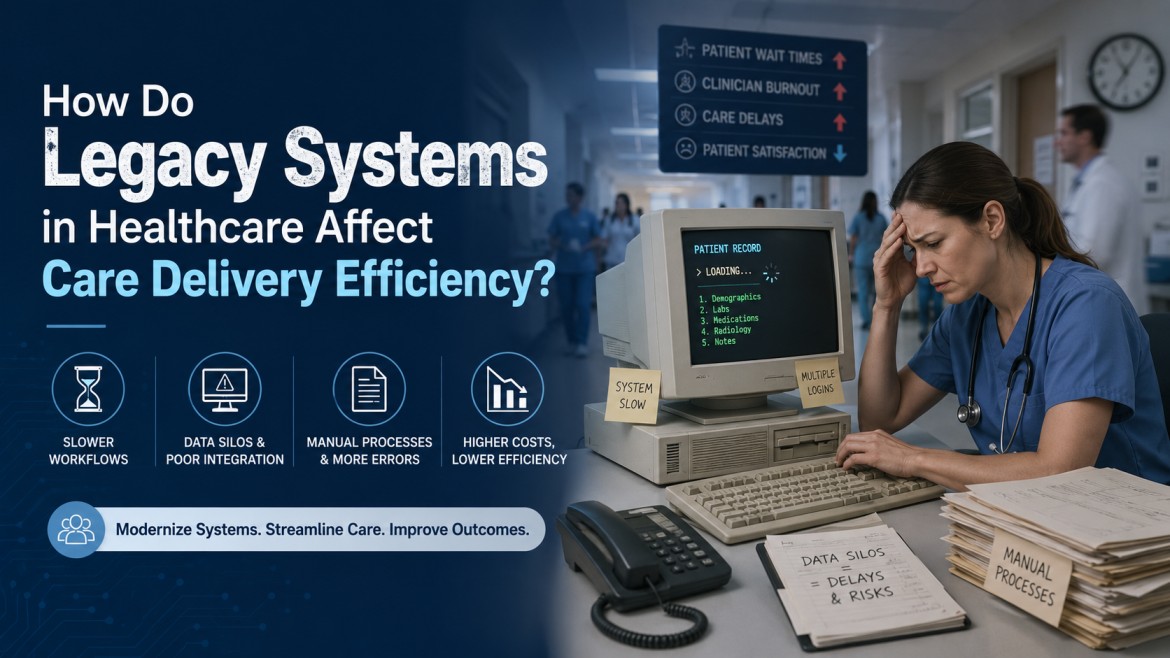
Legacy systems in healthcare reduce care delivery efficiency by slowing clinical workflows, fragmenting patient data, and forcing staff to rely on outdated, disconnected tools. Fixing this requires phased healthcare system integration and healthcare software modernization rather than a full rebuild. Walk into most hospital IT departments, and there’s a decent chance you’ll find software older than half the staff currently using it. Legacy systems in healthcare the scheduling tools, the billing platforms, the record-keeping databases nobody ever quite got around to replacing are still quietly running the back office at a lot of facilities. Nobody sat down and decided these should last twenty years. They just never got swapped out. And now, somehow, they’re the foundation everything else sits on top of.
Here’s the thing though: these tools were built for a much smaller, simpler version of healthcare. One department. One function. Not much data moving around. Today’s environment looks nothing like that. Multi-site networks, endless insurance paperwork, patient volumes nobody was planning for back when these platforms were designed. So healthcare operational efficiency takes the hit first, and honestly it doesn’t stay contained to IT for very long. Clinicians notice it in slow-loading charts. Administrators notice it in billing backlogs that never quite clear. Patients notice it too, eventually, even if they couldn’t tell you exactly why their visit felt so disorganized.
The global healthcare IT market is expected to hit $2,790.1 billion by 2033, expanding at a 23.2% CAGR growth largely fueled by organizations moving away from inefficient legacy systems toward cloud platforms, AI, and integrated software.
Source: GrandViewResearch
Legacy systems slow clinical workflows by forcing staff to re-enter data across disconnected applications, wait on slow-loading charts, and work without real-time visibility between departments. Ask a nurse how many separate systems they log into over one shift. The number’s almost always higher than it should be. Three different applications for what should really be one patient record, and since none of them talk to each other, the same information gets typed in three separate times by three separate people at three separate points in the day.
That’s the real pattern with legacy systems in healthcare. Not one big dramatic failure, just a steady drip of small friction, day after day:
None of that ruins a single shift on its own. String it together across a full year of shifts, though, and it adds up to a genuine drain on the whole operation. Healthcare workflow optimization is basically the industry’s name for undoing that drain by figuring out how information should actually move, so people spend less time fighting software and more time doing their jobs.
Legacy systems create billing errors, manual compliance reporting, and rising IT maintenance costs, pulling resources away from patient care and modernization. And it doesn’t stop at the bedside, not even close. Billing teams chase down errors that only happened because two systems described the same patient two different ways. Compliance staff builds reports by hand, one line at a time, because nothing exports cleanly. IT ends up spending its whole week just keeping the lights on instead of upgrading anything, because there’s rarely enough budget or time to do both.
| Problem Area | Impact on Providers |
|---|---|
| Data entry duplication | More staff hours, more room for error |
| System downtime | Delayed care, scheduling thrown off |
| Weak healthcare data integration | Records that don’t line up across departments |
| Aging healthcare IT infrastructure | Higher maintenance costs, more security risk |
| Manual reporting | Slower compliance and audit turnaround |
Put it all together, and you get what most people in the field just shorthand as healthcare technology challenges. It’s a fairly broad label, sure, but it fits capable teams held back by tools that were never built for the job they’re now stuck doing. The real fix usually isn’t a patch or a workaround. It’s healthcare software modernization done properly: replacing, or at least rebuilding, the pieces that no longer match how care actually happens day to day.
Legacy healthcare systems delay diagnoses, cause repeated tests, and limit care coordination by trapping patient data in disconnected systems, known as healthcare data silos. Somewhere down the line, this stops being an operations headache and turns into a patient problem. A doctor pulls up a chart and the history’s incomplete, not because the information doesn’t exist somewhere, but because it’s sitting in a different system that nobody thought to check that day. That’s essentially what healthcare data silos mean in practice: data that’s technically there, just unreachable exactly when someone needs it most.
For the patient sitting on the other end of that gap, it can look like:
Healthcare interoperability challenges sit underneath most of this, if you trace it back far enough. Interoperability just means one system can actually understand data coming from another one, and legacy infrastructure is, almost by definition, terrible at that. Without it, even a hospital full of excellent clinicians can’t really deliver the joined-up experience patients now expect as the bare minimum.
Hospitals stick with legacy systems because full replacement is expensive, risky, and disruptive to ongoing patient care, so most organizations modernize in phases instead. Fixing this isn’t a matter of will; it’s a matter of difficulty. Replacing core infrastructure is expensive and slow, and hospitals can’t pause care to do it, so old and new systems often run side by side for years while staff retrain and risk stays high. Decade-old compliance customizations make it harder still, which is usually why healthcare system integration linking new tools to existing ones in stages wins out over a full rip-and-replace.
That said, momentum is building. Healthcare digital transformation is more achievable now thanks to cloud infrastructure and AI-assisted tools, and healthcare process automation is taking scheduling, billing checks, and routine documentation off staff so clinicians can focus on judgment-based work. In practice, tackling healthcare IT challenges usually means cloud migration, API layers bridging old and new systems, automated validation, phased rollouts, and training built into each phase rather than added afterward.
At the end of the day, this was never really about old software being a minor inconvenience. It’s about whether care actually gets delivered efficiently, and whether the people delivering it can trust what’s on the screen in front of them. Improving efficiency in healthcare delivery starts with an honest, unflinching look at where legacy systems in healthcare are the real bottleneck, then a realistic plan for closing that gap gradually, not overnight.
Organizations that get this right tend to treat modernization as something ongoing, not a one-off project with a finish line. And that’s usually what shows up, eventually, as less strain on staff and genuinely better outcomes for the patients everyone’s actually there for.
Outdated platforms still used for scheduling, billing, and records; legacy healthcare systems that weren’t built for today’s data demands, causing ongoing healthcare technology challenges.
It duplicates work, increases errors, and creates healthcare data silos, directly hurting healthcare operational efficiency.
The shift to connected, cloud-based systems, usually driven by healthcare software modernization replacing outdated infrastructure.
It connects new and existing tools so data flows properly, solving healthcare interoperability challenges.
It cuts manual tasks like scheduling and billing checks, supporting healthcare workflow optimization.
Outdated infrastructure drives healthcare IT challenges; modernizing it improves efficiency in healthcare delivery and patient outcomes.
Join over 150,000+ subscribers who get our best digital insights, strategies and tips delivered straight to their inbox.