ChatGPT
 Grok
 Perplexity AI
ChatGPT
Grok
Perplexity AI
4 min read | By Muhammed Irbaz | 22 October 2026 | Ecommerce
An ecommerce tech stack is the combined set of software, architecture, and integrations powering an online store, including the storefront, inventory, payments, hosting, and APIs. A well-chosen stack, built on composable or headless architecture with strong integrations, directly determines scalability, performance, and how easily a business adapts as it grows.
Global ecommerce platform and software revenue is expected to grow significantly, reaching $5.05 trillion by 2030, up from $3.88 trillion in 2026.
Source: Statista
For engineering managers, tech leads, and VP Engineering roles, understanding the essential ecommerce technology stack components is where the real planning has to start, well before infrastructure decisions get locked in. This blog walks through what a reliable stack is made of, how architecture choices shape performance, why integration cannot be an afterthought, and what should guide the selection process.
An ecommerce tech stack is the combined set of software and services running an online store, and it matters because a well-planned one reduces technical debt while enabling faster growth.
An ecommerce technology stack is the combined set of software, frameworks, and services that keep an online store running, covering everything from the front-end interface a customer sees to the back-end systems handling data, transactions, and fulfillment behind the scenes. When the ecommerce development stack is planned well, technical debt shrinks, release cycles move faster, and engineering teams gain room to adjust as the business changes direction.
The stack itself is rarely just a set of tools picked off a shelf. It’s more of a long-term commitment, one a team ends up living with for years, sometimes longer than anyone planned for. Decisions made too quickly early on have a habit of resurfacing later as scaling bottlenecks, security gaps, or integration problems, and by that point, fixing them costs a lot more than preventing them would have.
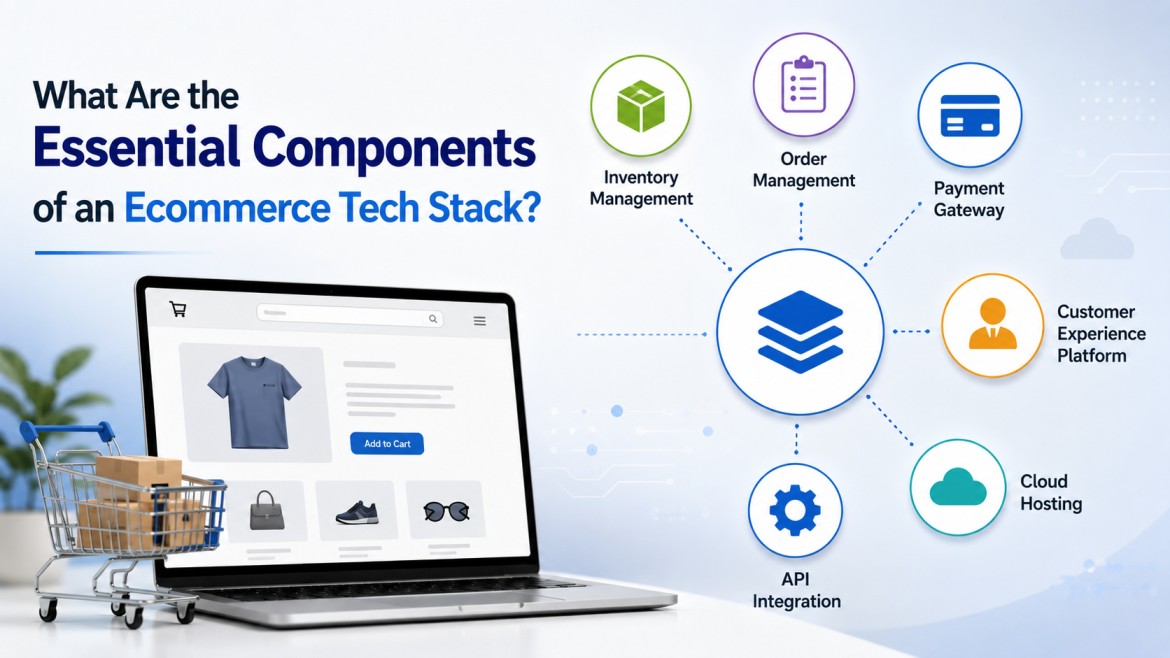
The essential components are the storefront, inventory and order management, payment gateway, customer experience platform, cloud hosting, and API integration.
A modern ecommerce technology stack brings together several interconnected layers, each handling a specific function within the platform, with progressive web app trends for ecommerce increasingly shaping how the storefront layer is built. Two architectural approaches stand out for teams that want flexibility built in from day one: composable commerce, where individual services can be assembled or swapped out on their own, and headless ecommerce, which keeps the front-end presentation separate from back-end logic so customer experiences can be updated without disturbing core systems.
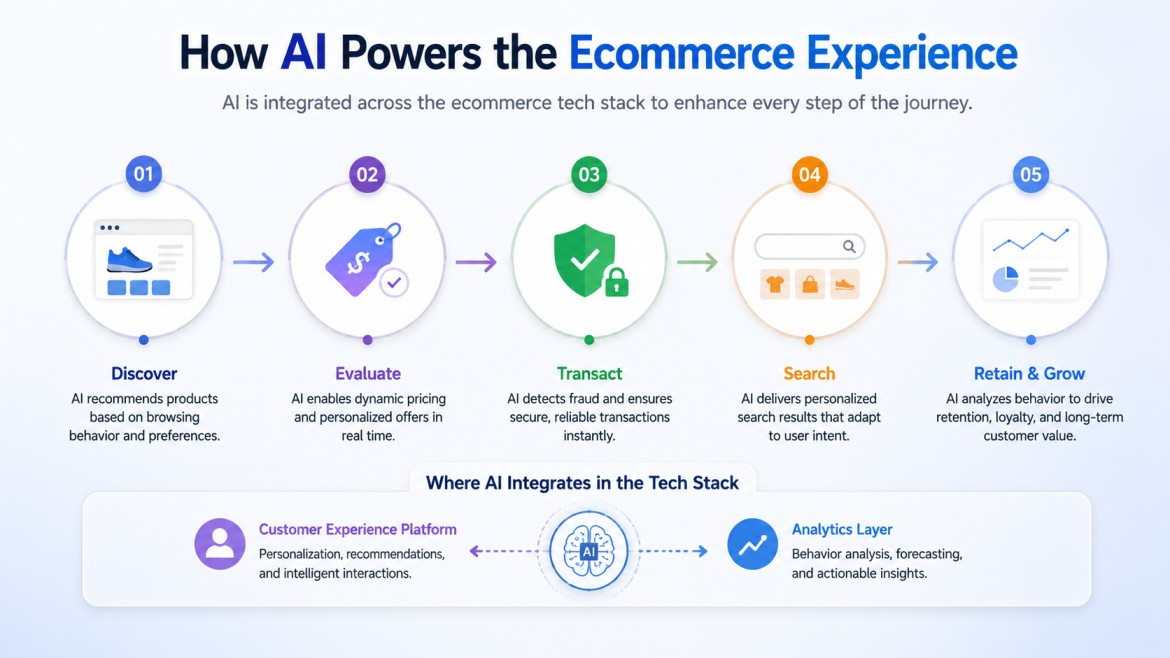
AI in eCommerce has increasingly become part of this modern stack, with AI agents personalizing customer experiences through product recommendations, dynamic pricing, fraud detection, and personalized search results that adjust to individual shopping behavior in real time. Rather than functioning as a standalone tool, AI typically integrates directly into the customer experience platform and analytics layer, making it a growing consideration for teams designing the stack rather than a separate system bolted on afterward.
The table below lists the core building blocks most technical teams need to account for:
| Component | Primary Function |
|---|---|
| Storefront/Frontend Layer | Delivers the customer-facing shopping experience |
| Inventory management system | Tracks stock levels across channels and warehouses |
| Order management system | Coordinates order processing, fulfillment, and returns |
| Payment gateway integration | Handles secure transaction processing |
| Customer experience platform | Personalizes interactions and supports retention, increasingly powered by AI in eCommerce for recommendations and behavioral targeting |
| Cloud hosting | Provides scalable infrastructure and uptime reliability |
| API integration | Connects third-party services and internal systems |
Each of these components plays a distinct role, but their real value emerges when they operate as a unified system rather than isolated tools.
Ecommerce architecture directly determines page load speed, system resilience, and how independently a platform can scale under growing traffic.
How a platform is architected shapes both how it performs under load and how easily it scales later. Older monolithic systems tend to buckle when traffic spikes or when a team needs to push new features quickly, which is part of why microservices architecture has caught on so widely. Breaking a platform into smaller, independently deployable services lets teams scale individual pieces without dragging the rest of the system along with it.
Architecture decisions around ecommerce architecture end up shaping things like:
Performance optimization works best as an ongoing habit rather than a one-time project, since caching strategies, database query efficiency, and a content delivery network for faster load times all factor in at different points. Businesses operating at scale generally need an enterprise ecommerce platform designed with growth headroom from day one. Retrofitting that headroom later, after traffic has already outpaced capacity, tends to be a far more complicated job.
Ecommerce integration keeps inventory, CRM, ERP, and shipping systems connected so data stays accurate across the business without manual entry.
Individual tools lose much of their value the moment they stop talking to each other. Ecommerce integration ties the stack’s various systems together, inventory, CRM, ERP, shipping, and analytics among them, so data moves accurately across the business instead of someone re-entering it by hand every time something changes.
Solid ecommerce software development practices keep integrations maintainable, secure, and able to withstand third-party API changes without breaking down. When integrations are done poorly, the fallout tends to show up as mismatched inventory counts, delayed order updates, or customer data scattered across systems that don’t talk to one another. These aren’t minor issues either; they hit daily operations and customer trust in fairly direct ways.
Teams working on ecommerce platform development are usually better off planning integrations during the architecture phase itself, not bolting them on once the storefront has already gone live.
Businesses should weigh scale requirements, growth trajectory, team capability, vendor flexibility, and long-term maintainability before choosing a stack.
Figuring out how to choose an ecommerce tech stack starts with lining up technical decisions against actual business goals instead of chasing whatever’s trending at the moment.
A few things worth weighing for engineering leadership:
Plenty of organizations end up working with an ecommerce development company or pursuing custom ecommerce development once internal resources run thin, or when a project calls for specialized integration expertise that isn’t available in-house. Bringing in an experienced ecommerce software development company or an enterprise ecommerce development team often catches architectural issues before they turn expensive to reverse. Ecommerce consulting services add something similar: an outside perspective that can spot gaps internal teams miss simply from being too close to their own systems day after day.
Building an ecommerce platform that actually holds up under growth takes more than picking popular tools off a list. It calls for architecture that’s been thought through properly, integrations that hold together under pressure, and a clear read on business priorities. Engineering leaders who treat an ecommerce tech stack as a strategic asset, rather than just a checklist of software, tend to be the ones better positioned when growth actually arrives, not scrambling after it already has.
For teams working through this complexity, ecommerce development services paired with ongoing ecommerce technology consulting can offer the kind of structured guidance that keeps a stack performing well today while leaving room to adapt tomorrow.
Timelines vary based on system complexity and the number of integrations required. Simple storefronts can launch in weeks, while enterprise-grade stacks with custom integrations often take several months.
Common technologies include cloud hosting, payment gateways, inventory and order management systems, and customer experience tools. Many setups also use API integrations and microservices architecture for flexibility and scale.
There is no single best stack, since the right choice depends on business size and growth plans. Enterprise businesses often need more robust architecture, while startups benefit from modular, low-overhead solutions.
Building a stack starts with aligning technology decisions to business goals, then selecting components for hosting, payments, and integrations. Architecture choices like composable commerce or headless ecommerce help the system scale over time.
Core components include the storefront layer, inventory and order management systems, payment gateway integration, and cloud hosting. A customer experience platform and API integrations round out the stack.
The right stack determines how easily a platform scales, integrates new tools, and adapts as traffic and business needs change. A poor choice often leads to costly rebuilds and scaling bottlenecks down the line.
Join over 150,000+ subscribers who get our best digital insights, strategies and tips delivered straight to their inbox.