ChatGPT
 Grok
Grok
 Perplexity AI
ChatGPT
Grok
Perplexity AI
Perplexity AI
ChatGPT
Grok
Perplexity AI
4 min read | By Muhammed Irbaz | 02 July 2026 | Artificial Intelligence
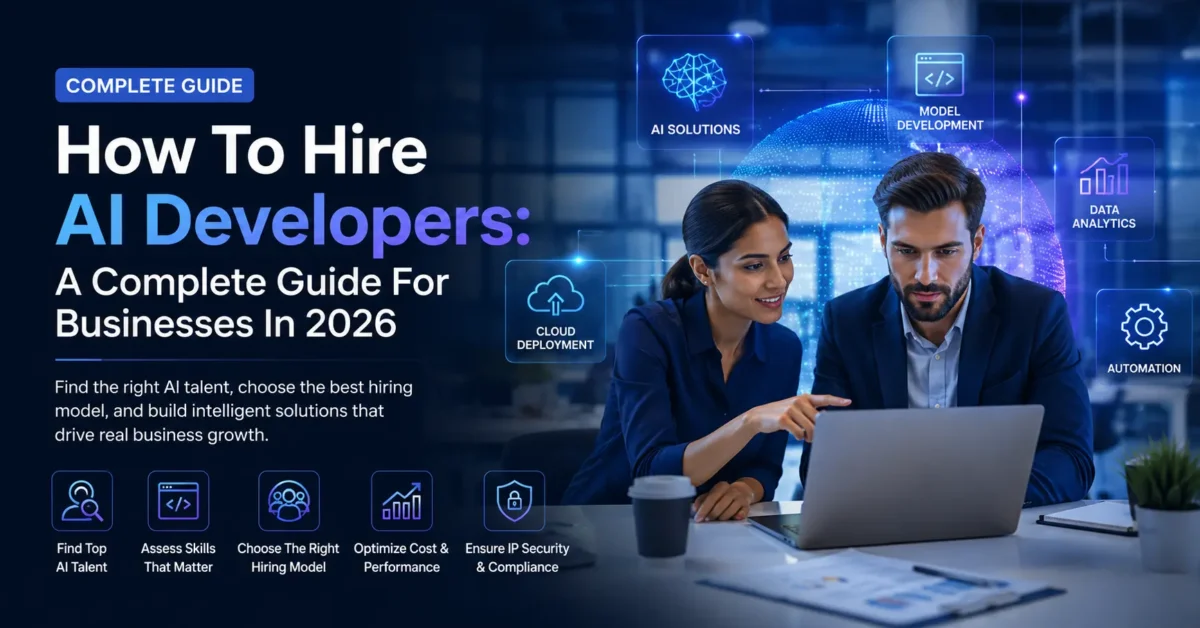
To hire an AI developer in 2026, businesses must pinpoint their specific project requirements such as Generative AI or Agentic workflow building, source through pre-vetted talent networks, AI staffing platforms, or specialized agencies, and align their budget based on region, project scope, and required expertise.
Whether an organization is building intelligent products, automating operations, or integrating AI development services into existing systems, finding the right talent is the critical first step. This guide walks through every stage of the hiring journey from understanding what AI developers do to evaluating costs, skill sets, and engagement models so companies can make confident, informed decisions.
● The first step in hiring the right AI developer is to understand the project’s requirements, such as the AI use case, the required expertise, and the business goals.
● Businesses can assess AI talent by considering problem-solving skills, communication and domain experience.
● The expenses associated with hiring AI experts can differ based on the hiring approach, geographic location, and specific expertise required
● The selection of the hiring method, such as in-house, outsourcing, or dedicated developers, can greatly affect the project’s overall performance in terms of speed, scalability, and outcomes achieved in the implementation of AI.
Source: grandviewresearch
At its core, an AI developer builds software that thinks. That means working with machine learning models, NLP pipelines, and automation tools that allow systems to learn from data, spot patterns, and make decisions on their own
AI engineers are different from general purpose developers because they aim to develop systems that can learn from data, detect patterns, and make decisions without human intervention.Unlike standard developers, AI engineers specifically build systems that improve over time through data not manual rule updates.
Common duties might involve:
● Creating machine learning models for prediction, classification, or generation tasks and training them.
● Building NLP and CV pipelines
● Embedding AI models in current software applications and systems
● Performing experiments, checking models and going back to modify them.
● Working with product teams, data engineers and business stakeholders.
There has been a great deal of extension in the scope in recent years. Many AI engineers focus on creating applications with large language models, or developing applications that have more autonomy in completing complex steps with little human intervention, which is called agentic AI. This is important in certain companies where they are specifically looking to recruit a certain type of expertise.
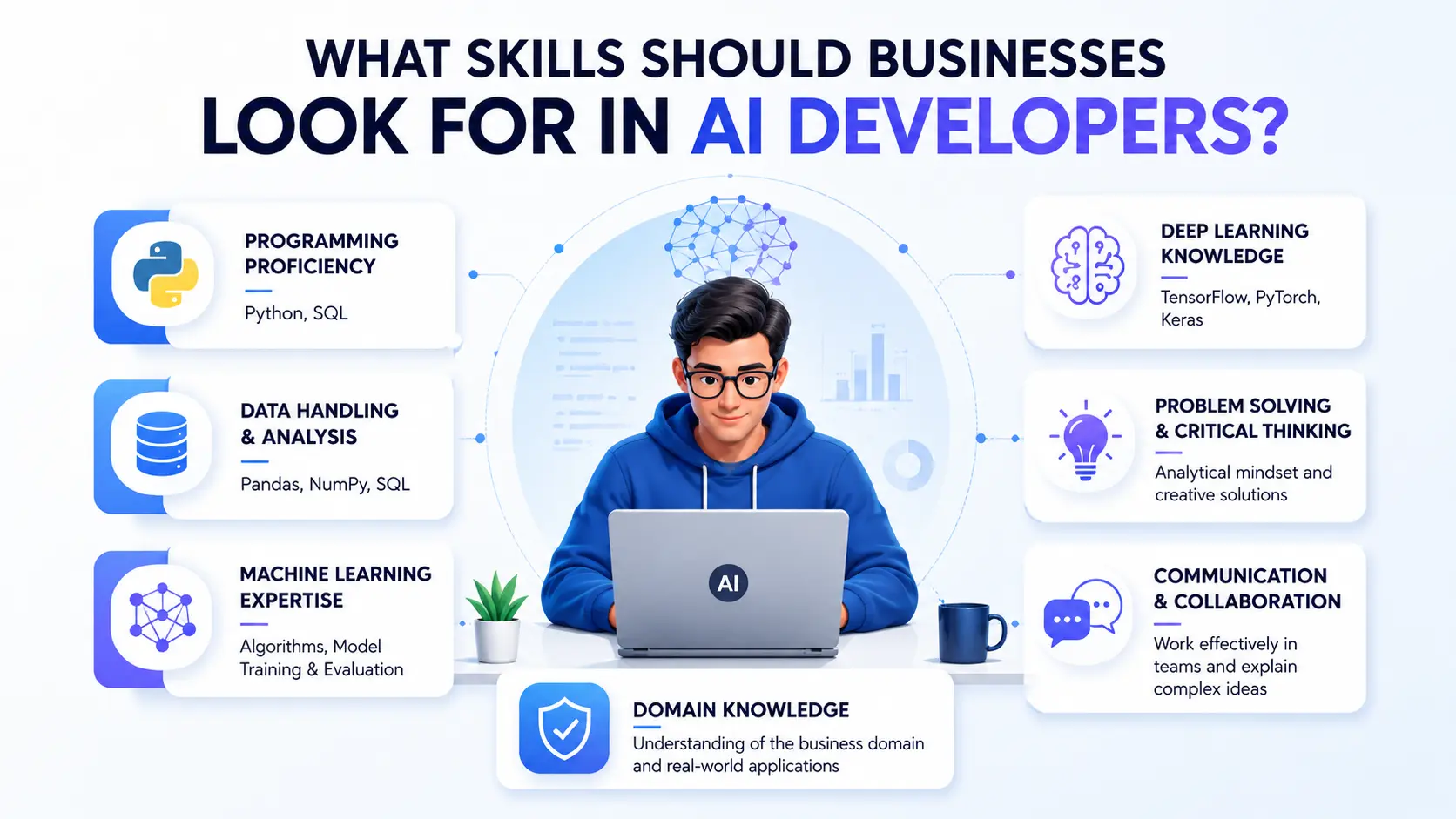
When evaluating AI developers, prioritize Python proficiency, ML frameworks like PyTorch and TensorFlow, cloud platforms, and real-world deployment experience.
Before engaging any AI outsourcing company or posting an AI expertise, organizations should define a precise skill profile. The table below maps core competency areas to specific skills worth evaluating:
| Skill Category | Key Skills to Evaluate | Why It Matters |
|---|---|---|
| Programming | Python, R, SQL, Scala | Foundational language for most AI/ML work |
| ML Frameworks | PyTorch, TensorFlow, Hugging Face | Tools for building and fine-tuning models |
| Cloud & MLOps | AWS SageMaker, GCP Vertex AI, Azure ML | Deploying and scaling models in production |
| Generative AI | LLM fine-tuning, RAG pipelines, prompt engineering | Critical for modern AI product development |
| Data Engineering | Spark, Kafka, Airflow, ETL pipelines | Ensures clean, reliable data feeding models |
| Domain Knowledge | NLP, Computer Vision, Reinforcement Learning | Signals depth in specific AI subfields |
| Soft Skills | Communication, research mindset, documentation | Bridges technical work with business goals |
However, AI experts with experience in shipping AI systems at scale, dealing with model drift, and fine-tuning their models based on production feedback add much more value to the table in an AI development team than theory alone.
Companies pursuing offshore AI developers or hiring through an AI development company should factor in project management capability, cross-cultural communication skills, and familiarity with IP protection practices when evaluating AI experts. The most technically skilled option is rarely the one with the lowest learning curve, so look beyond raw coding ability to how well a developer adapts to distributed, multi-stakeholder environments
When AI is central to a product long-term, building an in-house team makes sense. But for businesses that need to move fast or test an idea, working with an agency or consultant is usually the smarter starting point.
● Full IP, culture and roadmap alignment
● Ideal for organizations where AI is a key differentiator.
● More expensive at an initial cost but less expensive at marginal cost increases over time.
● Needs powerful HR systems for hiring ML engineers in bulk
● Accelerated ramp-up of vetted and specialized talent pool
● Perfect for MVPs, PoCs, or adding to existing teams.
● Architecture advice and strategic guidance is often part of AI consulting services provided by agencies.
● Limited visibility of the day-to-day with in-house teams
● Gives in-house control the options of outsourcing
● Specialists can be easily integrated into the current workflow and tools
● Suitable for companies with their own tech leads, but require execution capacity.
| Factor | In-House | Agency / AI Dev Company | Dedicated Model |
|---|---|---|---|
| Speed to Start | Slow (2–4 months) | Fast (1–3 weeks) | Moderate (2–4 weeks) |
| Cost | High | Medium–High | Medium |
| Control | Full | Limited | High |
| Scalability | Slow | High | High |
| IP Security | Maximum | Requires NDA | Requires NDA |
| Best For | Core product AI | Project-based AI | Team augmentation |
The fastest way to safely hire top AI developers is to combine clear job definitions with pre-vetted sourcing channels, and deploy practical technical assessments that match with everyday workflows. Moving quickly through the interview pipeline ensures to secure high-demand engineers ahead of competing offers.
Organizations often find the easiest method to recruit AI professionals without any mistakes is to adopt a structured and parallel approach:
Before reaching out to any AI experts companies or posting on job boards, organizations should document the specific AI subfield required, the deployment environment, and whether the role demands research or engineering focus.
● Pre-vetted AI talent marketplaces for fast, quality-checked hires
● LinkedIn Recruiter with AI-specific filters for direct outreach
● Referrals from existing AI engineers the highest signal-to-noise channel
● Partnering with an AI development company for managed placement
Generic coding tests do not predict AI developer performance. The evaluation should include a realistic take-home task such as fine-tuning a small model on a sample dataset, building a RAG pipeline, or debugging a production model that reflects actual day-to-day responsibilities.
AI engineers working within a cross-functional AI development team must communicate model outputs, limitations, and trade-offs to non-technical stakeholders. A structured interview round testing this competency reduces friction post-hire.
Top AI talent receives multiple offers simultaneously. Companies that delay more than 5 to 7 business days after final interviews lose AI professionals at a disproportionately high rate. Pre-approved compensation bands remove this bottleneck entirely.
partnering with established AI experts, companies provide faster access to experienced specialists than traditional recruitment methods.
Getting AI hiring right comes down to knowing what’s needed, what’s within budget, and how fast results are required. There’s no perfect formula, but starting with a clear problem statement makes every decision after it easier.Successful organizations begin by defining project requirements, evaluating critical skills, and selecting a hiring model aligned with long-term objectives.
Whether the need involves an internal AI development team, external specialists, or project-based resources, the right hiring strategy can significantly improve implementation success for strategic guidance.
For organizations ready to move forward, the smartest next step is to clearly define the AI problem being solved first then find the dedicated agentic AI developers best equipped to solve it. The right developer, in the right model, with the right brief, is the foundation every successful AI initiative is built upon.
Businesses can find reliable AI developers through pre-vetted AI talent marketplaces, or via LinkedIn and AI outsourcing companies that offer curated, pre-screened talent pools.
AI developers build complete AI-powered applications, while ML developers focus on designing and optimizing machine learning models.
AI developers should be proficient in Python, ML frameworks, and cloud platforms, with hands-on experience in NLP or computer vision and strong communication skills.
In-house developers suit long-term, IP-sensitive projects, while outsourcing works best for project-based needs, faster ramp-up, and cost-efficient scaling.
Healthcare, fintech, e-commerce, legal tech, and media benefit most essentially any sector dealing with large volumes of unstructured data or repetitive knowledge work.
AI consultants help businesses identify use cases, choose the right tech stack, and build implementation roadmaps, reducing risk and improving deployment success.
Join over 150,000+ subscribers who get our best digital insights, strategies and tips delivered straight to their inbox.