ChatGPT
 Grok
Grok
 Perplexity AI
ChatGPT
Grok
Perplexity AI
Perplexity AI
ChatGPT
Grok
Perplexity AI
4 min read | By Muhammed Irbaz | 26 June 2026 |
The software development industry is entering a new phase in 2026 with the rise of artificial intelligence-powered programming approaches. One of the biggest discussions among developers and businesses in vibe coding vs traditional coding 2026 . Although traditional coding has been the core of software engineering practices for several decades now, vibe coding provides an innovative approach to building apps with the help of artificial intelligence and automation.
With the increasing prevalence of AI programming tools, AI-assisted coding, and generative AI in software development, the software development process is becoming easier and faster. However, this does not mean traditional coding is disappearing. Instead, the future of AI development services are moving toward a combination of human expertise and AI-powered software development.
This article explores the differences between vibe coding and traditional coding, the benefits and limitations of both approaches, and the future of coding and software engineering in 2026.
| Comparison Factor | Vibe Coding | Traditional Coding |
|---|---|---|
| Definition | An AI-assisted development approach where developers use natural language instructions to create, modify, and improve software with the help of AI tools. | A conventional AI development company approach where developers manually write, test, debug, and maintain code. |
| Development Process | Focuses on describing ideas and goals, with AI helping generate code and solutions. | Focuses on writing code step-by-step based on technical requirements and designs. |
| Coding Method | Uses AI code generation, prompts, and AI coding assistants to create software faster. | Uses programming languages, frameworks, and developer-written logic to build applications. |
| Role of Developer | Acts as a guide, reviewer, and problem solver who works with AI tools. | Acts as the primary creator responsible for designing and writing code. |
| Speed of Development | Faster for prototyping, experimentation, and creating initial versions of software. | Usually takes more time because developers handle most tasks manually. |
| Required Skills | Requires basic coding knowledge along with the ability to effectively use AI tools. | Requires strong programming knowledge, logic skills, and software engineering expertise. |
| Flexibility | Allows quick changes and experimentation through AI-assisted modifications. | Changes may require more manual effort, especially in complex applications. |
| Best Use Cases | Rapid prototypes, simple applications, idea testing, and faster development workflows. | Large-scale applications, complex systems, enterprise software, and long-term projects. |
| Testing & Debugging | AI tools can assist with finding errors, but human review is still needed. | Developers manually test, debug, and optimize the software. |
The benefits of vibe coding for software development are becoming increasingly important as businesses look for faster and smarter ways to build applications.
One of the biggest advantages of vibe coding is speed. AI coding assistants can generate code structures, suggest solutions, and automate repetitive tasks, helping developers complete projects faster.
AI-assisted coding allows developers to spend less time on repetitive programming tasks and more time focusing on innovation, problem-solving, and user experience.
With AI developer tools, teams can improve efficiency and increase overall developer productivity.
Vibe coding makes it easier to test new ideas quickly. Businesses can build prototypes and minimum viable products without spending significant time on initial development.
People with limited programming experience can use AI-powered development platforms to create software solutions by describing their requirements.
Companies using AI software development methods can experiment with new ideas and launch products faster in competitive markets.
Vibe Coding is an AI-assisted coding approach where developers use natural language prompts to create, modify, and improve software with the help of AI tools. It helps speed up development and makes coding more accessible.
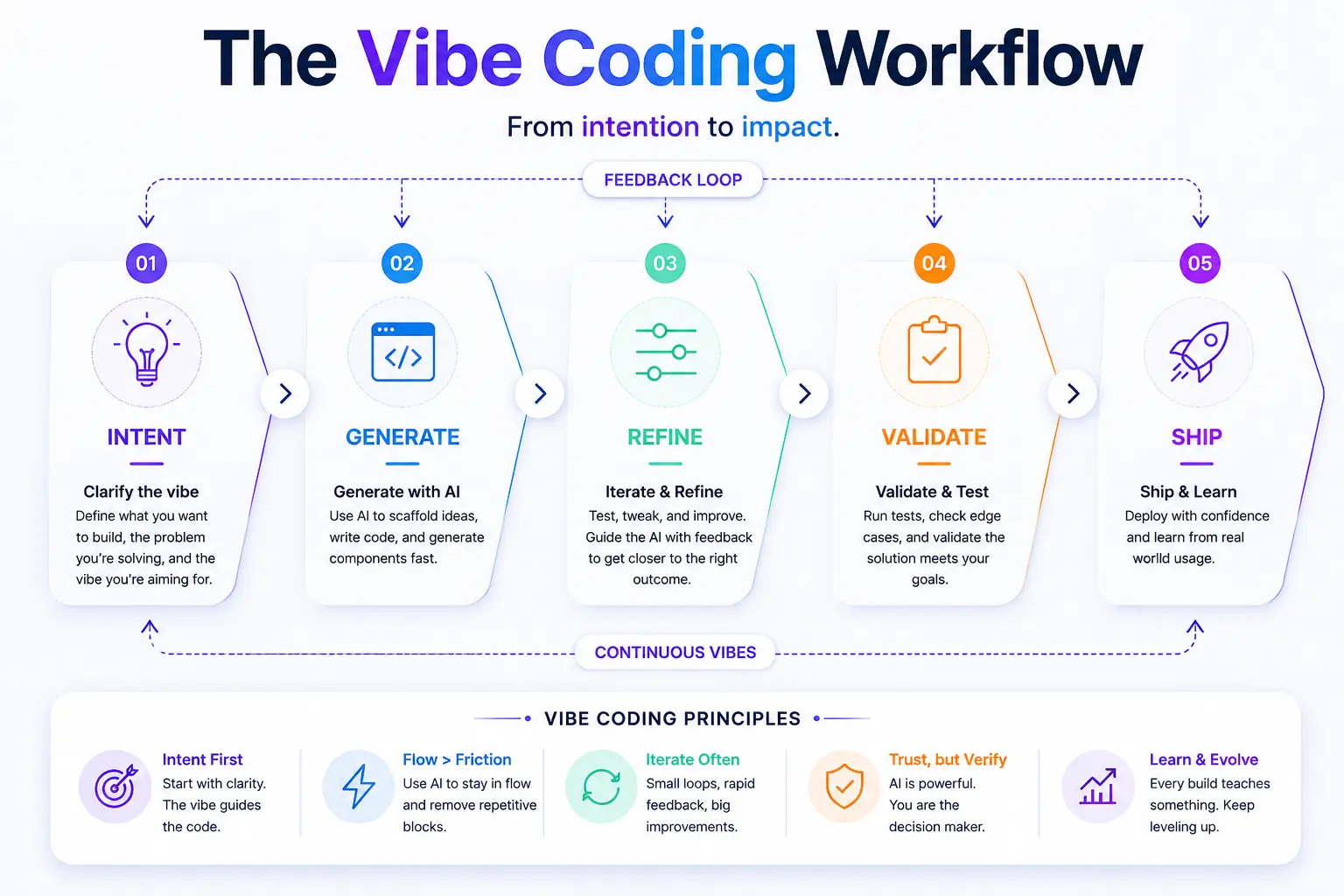
vibe coding does not replace traditional software development in 2026. In 2026, vibe coding becomes another approach used by developers in order to change the process of software development through adding AI-based help to the software development process.
Traditional software development remains essential as complex applications require adequate architecture, security, testing, scalability, and maintenance. Experienced developers are needed for developing systems, code review, solving different technical issues and making right engineering decisions.
Vibe coding has become very popular as it provides fast work for developers through using different types of AI-based tools such as AI coding, AI coding assistants, and AI-based code generation. With the help of AI coding developers can generate prototypes, automate their tasks and test their ideas but still need to review the AI-generated code as it requires quality checking.
In 2026, the process of software development is expected to include both methods.
Vibe coding is turning out to be an instrument which increases efficiency of developers as well as enables development of applications through the use of artificial intelligence. The best development methodology will involve creativity, knowledge about programming and artificial intelligence.
Traditional coding has built the foundation of modern technology, but it also has some challenges.
Writing software manually requires significant time, especially for large and complex projects.
Developers often spend hours creating similar code structures, debugging issues, and performing routine updates.
Large software projects require skilled developers, longer timelines, and extensive testing, increasing overall costs.
Becoming proficient in programming requires years of learning and continuous practice.
Despite these limitations, traditional coding remains essential because it provides control, reliability, and customization.
The future of coding and software engineering in 2026 would involve the interaction of both human experience and artificial intelligence.
Coding by AI, AI-based coding assistance, and generative AI coding would aid developers in coding at a much faster pace and performing mundane tasks, making them highly productive.
Nonetheless, traditional coding would continue to remain essential for creating secure, efficient, and reliable software applications. Developers would shift their attention towards problem-solving, innovation, and other such issues instead of just coding.
AI-enabled software development is bound to emerge as an integral aspect of modern software development workflows. The future of coding would thus be characterized more by the improvement of human skills by way of better tools and intelligent human-AI collaboration.
Discussion of vibe coding vs traditional coding is one of the largest steps in the development of software. While traditional coding offers stability, controllability, and engineering skills, vibe coding allows for speed, automation, and innovation thanks to the use of artificial intelligence.
By 2026, the best software developers and organizations will not stick to just one option. They will blend traditional programming skills and AI coding to develop the best software solution available.
The future of software development does not lie in choosing between humans and artificial intelligence. It lies in combining both to get the best result.
In cases of rapid application development and prototyping and also in terms of the usage of AI, Vibe Coding is better. Traditional Coding is better in situations where there is a need for customization, security, control, and complexity of software solutions.
No, Vibe Coding is not replacing Traditional Coding. Vibe Coding is simply allowing developers to develop applications faster due to AI assistance. However, developers’ programming skills are still essential in creating applications that work.
Yes, the AI can write production code. But, it will be important for developers to validate the generated code in order to correct mistakes and to make the code secure and efficient.
Yes, AI coding tools should be used by developers to automate coding processes and make them more productive. However, developers will need coding skills to be able to control code generated by AI.
In the future of coding in 2026, developers will work with AI tools that will help developers to develop software solutions in 2026.
The problem with Vibe Coding is that it can generate erroneous code, which requires programming skills to check it and fix problems.
Join over 150,000+ subscribers who get our best digital insights, strategies and tips delivered straight to their inbox.