ChatGPT
 Grok
Grok
 Perplexity AI
ChatGPT
Grok
Perplexity AI
Perplexity AI
ChatGPT
Grok
Perplexity AI
4 min read | By Muhammed Irbaz | 26 June 2026 | Software Development
The healthcare industry is rapidly evolving, driven by technological innovation and growing patient expectations. Healthcare organizations today require more than standalone applications to manage operations and deliver quality care. They need a connected healthcare software ecosystem that enables seamless communication, efficient workflows, and secure data exchange.
As organizations pursue healthcare digital transformation, the demand for integrated healthcare software systems continues to grow. From Electronic Health Records (EHRs) and telemedicine platforms to analytics tools and patient portals, modern healthcare relies on a broad network of interconnected technologies. This shift has made healthcare software modernization a strategic priority for providers seeking to improve patient outcomes, operational efficiency, and regulatory compliance.
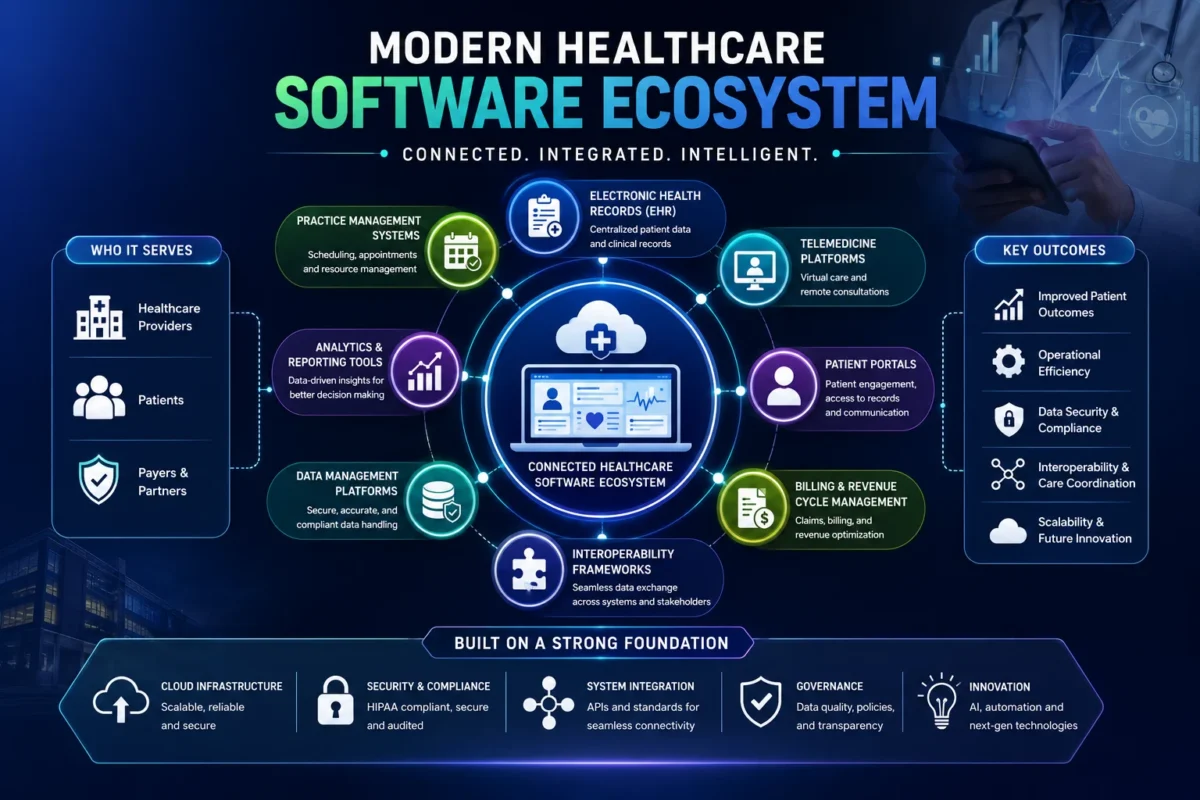
A healthcare software ecosystem is a collection of interconnected digital platforms, applications, and services that work together to support healthcare delivery, administration, and patient engagement. Rather than operating isolated systems, healthcare organizations use integrated solutions that share information across departments and stakeholders.
A modern healthtech ecosystem connects clinical, operational, financial, and patient-facing systems into a unified environment. This modern ecosystem enables healthcare professionals to access real-time information, collaborate effectively, and make informed decisions.
Key elements of a healthcare software ecosystem include:
● Electronic Health Records (EHRs)
● Practice management platforms
● Telemedicine solutions
● Patient portals
● Billing and revenue cycle systems
● Analytics and reporting tools
● Healthcare information systems
● Data management platforms
● Interoperability frameworks
Together, these technologies create a comprehensive healthcare software solution that supports both healthcare providers and patients.
A successful healthcare software ecosystem consists of multiple interconnected components designed to improve care delivery and streamline operations.
EHR systems serve as the foundation of many healthcare information systems. They centralize patient records, treatment histories, prescriptions, laboratory results, and clinical documentation.
Leading platforms such as Epic healthcare software help providers manage patient information efficiently while supporting coordinated care.
Modern healthcare management software helps organizations oversee scheduling, billing, resource allocation, staffing, and administrative workflows. These systems reduce manual effort while improving operational efficiency.
Telehealth solutions have become essential within the modern healthtech ecosystem. These platforms enable virtual consultations, remote monitoring, and digital communication between patients and healthcare professionals.
Healthcare organizations increasingly rely on analytics platforms to evaluate performance, monitor patient outcomes, and identify opportunities for improvement. These advanced healthcare technology solutions provide actionable insights that support data-driven decision-making.
This ensures that information remains accurate, secure, and accessible. Data management systems help organizations handle large volumes of clinical and operational information while maintaining compliance with industry regulations.
By integrating these components, organizations create a scalable healthcare software solution capable of supporting long-term growth and innovation.
Electronic Health Records are often considered the backbone of modern software systems. They provide healthcare professionals with immediate access to patient information, helping improve both clinical and administrative processes.
EHR platforms allow providers to access comprehensive patient histories, diagnoses, medications, and treatment plans from a centralized location. This improves decision-making and reduces the risk of medical errors.
Clinical teams across different departments can securely share patient information, supporting better collaboration and continuity of care. This capability is especially important for organizations focused on improvement.
Clinical systems automate many routine tasks, including documentation, prescription management, appointment scheduling, and laboratory result tracking. These efficiencies allow healthcare professionals to spend more time focusing on patient care.
Modern healthcare information systems support compliance with healthcare regulations by maintaining accurate records and secure audit trails.
Solutions such as Epic healthcare software enable authorized users to access patient data across multiple locations, supporting coordinated care and operational efficiency.
Many healthcare organizations still operate legacy systems that limit efficiency, scalability, and innovation. This helps address these challenges by replacing outdated technologies with flexible and integrated digital solutions.
Modernization initiatives often include:
● Cloud migration
● System integration
● Infrastructure upgrades
● Application modernization
● Enhanced cybersecurity
● Advanced analytics implementation
One of the most significant outcomes of healthcare software is improved healthcare interoperability. Interoperable systems enable different applications to exchange information seamlessly, improving communication between providers, departments, and healthcare networks.
Modern healthcare environments require robust security measures. Through healthcare software modernization, organizations can implement advanced encryption, access controls, and threat monitoring capabilities to protect sensitive patient data.
Cloud-based healthcare IT solutions provide organizations with the flexibility to scale operations while reducing infrastructure costs. These platforms also support continuous innovation and faster deployment of new services.
By modernizing legacy applications and infrastructure, healthcare providers can advance their strategies while improving operational efficiency and patient experiences.
Innovation remains essential for addressing evolving healthcare challenges. Healthcare software development enables organizations to create new technologies that improve care delivery, enhance patient engagement, and optimize operations.
Several innovation areas continue to shape the future of healthcare:
AI-powered applications support diagnostics, predictive analytics, personalized treatment recommendations, and clinical decision support systems.
Connected devices and digital platforms allow healthcare providers to monitor patients remotely, improving chronic disease management and preventive care.
Modern healthcare applications help patients access services, schedule appointments, communicate with providers, and manage personal health information from anywhere.
Data-driven insights generated through sophisticated analytics platforms help organizations improve efficiency, reduce costs, and enhance patient outcomes.
Organizations increasingly rely on specialized medical software development teams to create tailored applications that align with their operational and clinical objectives. Through healthcare application development, providers can build innovative solutions that integrate seamlessly with existing systems.
These investments in healthcare software development continue to strengthen the broader healthcare software ecosystem and support ongoing innovation.
A modern healthcare software ecosystem is far more than a collection of individual applications. It is a connected network of technologies that supports patient care, operational efficiency, and organizational growth.
Core components such as EHR platforms, telemedicine tools, analytics solutions, healthcare information systems, and data management platforms work together to create a cohesive digital environment. Through effective healthcare software modernization, organizations can strengthen and improve data management and accelerate initiatives.
As healthcare continues to evolve, investments in healthcare software modernization services and healthcare software development will play a critical role in shaping the future of care delivery. Organizations that embrace this modern ecosystem will be better positioned to improve patient outcomes, optimize operations, and achieve long-term success.
A healthcare software ecosystem includes EHR platforms, telemedicine solutions, patient portals, healthcare management systems, analytics tools, and data management platforms that work together to support care delivery and operations.
Healthcare software modernization helps organizations improve system performance, enhance security, enable better data exchange, and support scalable digital healthcare services.
EHR systems provide centralized access to patient records, improve care coordination, reduce manual tasks, and help healthcare professionals make faster, informed decisions.
Interoperability allows different healthcare applications and systems to exchange data seamlessly, improving communication between providers and enhancing patient care.
Healthcare software development enables the creation of advanced solutions such as AI-powered tools, mobile health applications, remote monitoring platforms, and customized medical software.
Join over 150,000+ subscribers who get our best digital insights, strategies and tips delivered straight to their inbox.