ChatGPT
 Grok
Grok
 Perplexity AI
ChatGPT
Grok
Perplexity AI
Perplexity AI
ChatGPT
Grok
Perplexity AI
4 min read | By Muhammed Irbaz | 26 June 2026 | Artificial Intelligence
Most software still waits to be told what to do. That’s changing fast. Teams across industries are now building AI agents capable of planning tasks, reaching into outside tools, and carrying work through to completion without someone watching every single step. This guide breaks down what building AI agents actually looks like in 2026: the core components involved, the framework teams are turning to, and the path a company typically follows to move from a rough idea to something running in production.
The AI agents market is set to expand sharply, rising from $10.9 billion in 2026 to an estimated $182.9 billion by 2033, reflecting a 49.6% CAGR. North America currently leads in market share, while Asia Pacific is expected to grow the fastest.
Source: GrandViewResearch
Building an AI agent in 2026 takes reasoning, memory, tool access, and a way for the agent to check its own work before acting. Wiring a language model to an API and calling it an agent doesn’t hold up anymore. Real agents need reasoning, some form of memory, access to tools, and a way to check their own work before they act on it.
Before jumping into how to build an AI agent, it helps to understand how AI agents work in the first place. Most of them run on a loop: take in a goal, split it into smaller steps, pick a tool or data source, act, then look at what happened before deciding what to do next. That loop is really the whole difference between an agent and a script that just runs on a schedule.
A few pieces show up in nearly every serious AI agent development project:
| Component | Purpose |
|---|---|
| Language model | Drives reasoning and language understanding |
| Memory layer | Keeps context between sessions and tasks |
| Tool/API connectors | Gives the agent a way to act: search, query a database, run code |
| Orchestration layer | Manages the sequence of steps and decisions |
| Evaluation layer | Catches mistakes before the agent commits to an action |
Anyone researching how to build AI agents is usually better off starting small. A narrow, specific task beats a general-purpose assistant almost every time, mostly because it’s easier to test and easier to catch when something goes wrong.
AI agent development follows seven core steps: define the objective, choose the architecture, handle memory, connect tools, build orchestration, test, and deploy. There’s no single blueprint for AI agent development, but most teams end up following roughly the same path, even across very different industries:
None of these steps are optional, though the order sometimes shifts depending on how the team works.
LangGraph, CrewAI, AutoGen, Semantic Kernel, and LlamaIndex agent tools are the most widely used AI agent frameworks in 2026. Picking among the various AI agent frameworks out there really comes down to what the team already knows, how much the system needs to scale, and whether a human is expected to double-check the agent’s work.
A handful of names keep coming up in 2026:
There isn’t really a “best” framework here. Most teams weigh AI agent orchestration support, how well it plugs into what they already run, and how active the community is, then pick whichever fits their situation rather than chasing whatever’s trending.
A company typically moves from idea to a working AI agent through a small pilot, limited tools, controlled testing, and a phased deployment plan. Getting from an idea to something that actually runs takes more coordination than most people expect; going in, it’s rarely just a technical problem. A rough version of how it tends to play out:
Common AI agent use cases companies lean on during this stretch include customer support triage, searching internal documents, helping with code review, qualifying sales leads, and automating pieces of finance or operations work. The companies that get this right tend to treat the agent as something that keeps evolving, not a project that’s ever really “done.”
Building AI agents in 2026 relies on foundation models, vector databases, orchestration frameworks, tool integrations, and monitoring infrastructure. A working agent stack is rarely just one tool; it’s usually a handful of layers stacked together. Here’s roughly what that looks like across the industry right now:
| Layer | Common Technologies |
|---|---|
| Foundation models | Large language models with reasoning and function-calling support |
| Vector databases | Store embeddings so the agent can pull in relevant context |
| Orchestration frameworks | LangGraph, CrewAI, AutoGen, Semantic Kernel |
| Tool integration | REST APIs, internal databases, browser automation |
| Monitoring & observability | Tools that track what the agent decided and why |
| Deployment infrastructure | Cloud runtimes, containers, serverless functions |
People looking into how to develop AI agents often skip past the monitoring layer, or treat it as an afterthought. That’s a mistake once an agent starts making its own calls; having a way to catch unexpected behavior matters just as much as the model driving it.
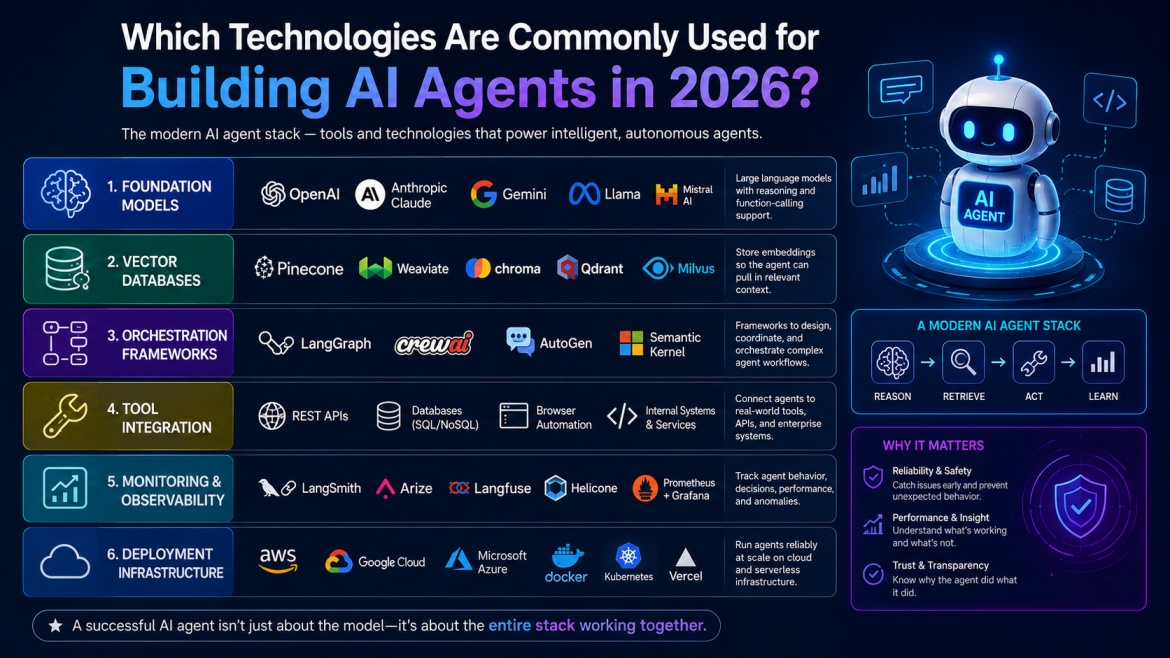
Building AI agents in 2026 isn’t really about grabbing the flashiest model available. It’s about the system built around it: memory, tools, orchestration, and someone keeping an eye on things, all working together. Companies that treat AI agent development as a focused, narrow project with the right framework and a real deployment plan tend to get further, faster, than the ones aiming straight for a fully autonomous, do-everything agent on day one. As frameworks settle and AI agent architecture patterns become more standard, starting will only get easier, which makes now a reasonable time for most businesses to give it a try.
Building AI agents in 2026 calls for a solid architecture, reliable tools, and a clear understanding of how AI agents work before development begins.
Teams typically define the objective, choose the AI agent architecture, and build orchestration logic before moving into full AI agent development.
AI agents work by taking in a goal, breaking it into smaller steps, then choosing a tool or data source, taking action, and evaluating the result before deciding what to do next.
LangGraph, CrewAI, and AutoGen are commonly used AI agent frameworks that help manage AI agent orchestration across multi-step workflows.
Popular AI agent use cases include customer support triage, document search, and workflow automation across finance and operations teams.
AI agent deployment involves monitoring, fallback planning, and human oversight, key steps outlined in most AI agent development guides for 2026.
Join over 150,000+ subscribers who get our best digital insights, strategies and tips delivered straight to their inbox.