ChatGPT
 Grok
Grok
 Perplexity AI
ChatGPT
Grok
Perplexity AI
Perplexity AI
ChatGPT
Grok
Perplexity AI
4 min read | By Admin | 03 March 2026 |
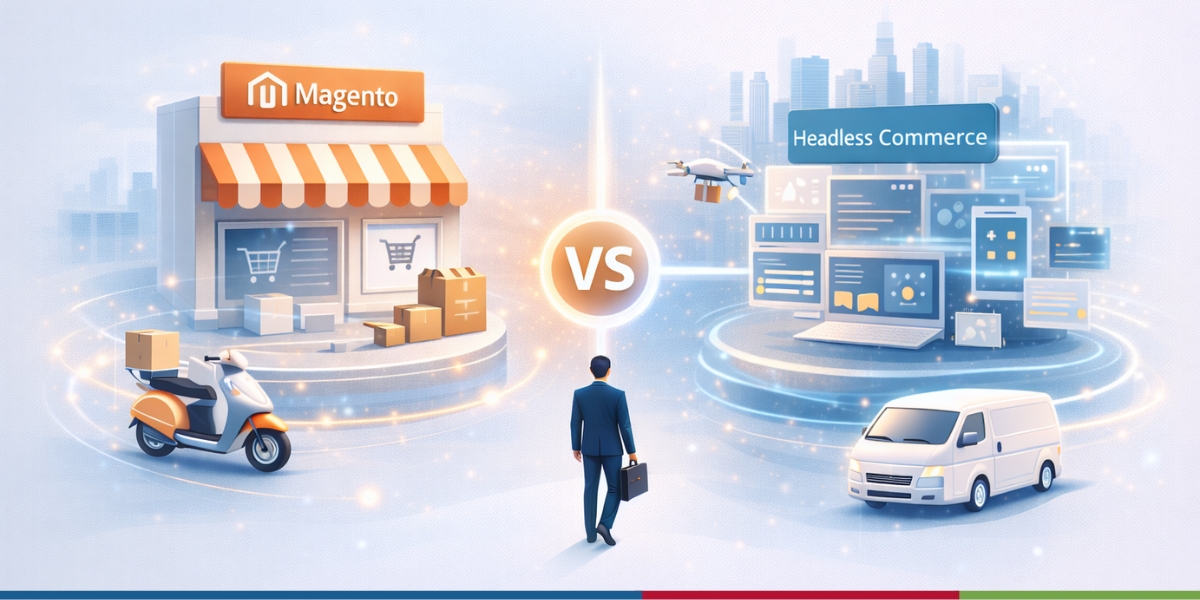
The digital commerce sector for 2026 requires more than online store establishment beyond its current state. The organization needs to provide customers with quick and personalized service through multiple interaction points. The technological systems used by companies to operate their digital storefronts become essential for their international business expansion and their development of new online customer service channels. This is the point when people need to evaluate Magento against headless commerce solutions. The Magento system delivers an organized and powerful environment, but headless commerce architecture enables users to build their systems without restrictions. The decision to choose between magento and headless commerce requires organizations to understand their needs for scalability and customization and their plans for future development.
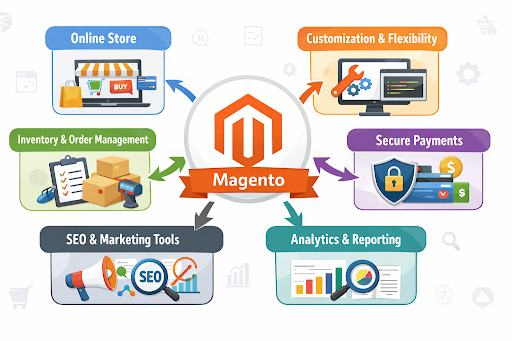
The Magento platform provides eCommerce businesses with an efficient and scalable system to run their online stores. The platform maintains its original name Magento which Adobe now owns as Adobe Commerce to provide businesses with efficient eCommerce tools that handle product management and order processing and customer handling and personalized shopping experiences.
It is famous for its customization options. It allows businesses to customize their themes, add functionality by extending other services, and provide a custom storefront experience based on their business. The ecommerce platform of Magento is suitable for multi-store, language, and currency functionality. This makes it suitable for global enterprises.
Magento ecommerce features built-in tools to handle marketing automation and analytics and catalog management and B2B ecommerce operations. The developers of Magento Commerce created an exceptionally scalable solution which enables businesses to fulfil their advanced operational requirements.
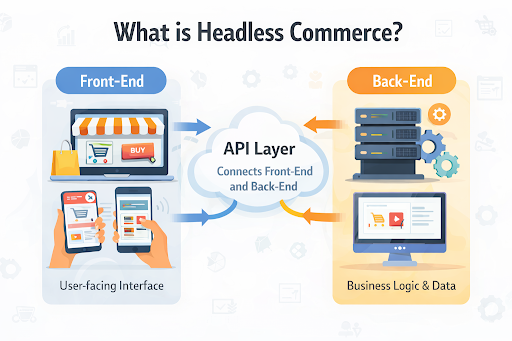
Headless commerce is a term that describes an eCommerce solution in which the front end, or the part of the system that the customer sees, is separated from the back end, or the part of the system that handles things like products, orders, payments, and data. This is in contrast to traditional eCommerce solutions, which are all connected. The benefits of headless commerce, as opposed to traditional eCommerce solutions, are that it uses APIs to connect the two.
Developers are able to create experiences for websites, mobile, kiosks, or even smart devices without affecting the back-end functionality, which can still handle things like inventory and checkout.
Headless commerce advantages are particularly useful for growing businesses that need faster performance, more personalized experiences, and the ability to sell across multiple channels.
| Basis | Magento | Headless Commerce |
|---|---|---|
| Architecture | Monolithic architecture where front end and back end are tightly integrated | Decoupled architecture where front end and back end run independently |
| Flexibility | Less flexibility in the front end of the platform | Freedom to create custom front ends using any framework |
| Customization | Customization is possible but can be complex and time-consuming | Highly customizable without impacting backend functionality |
| Performance | Performance depends on full system load and theme optimization | Faster performance as the front end is optimized separately, showing how headless commerce works. |
| Development Speed | Changes often require backend adjustments | Front-end updates can be done independently |
| Omnichannel Retail Strategy | Primarily web-focused with extensions | Easily supports web, mobile apps, IoT, kiosks, and multiple channels |
| Scalability | Scaling may require full system upgrades | Front end and back end can scale independently |
| Innovation | Slower experimentation due to tightly coupled structure | Faster innovation with API-driven approach |
Headless commerce system solution delivers modern ecommerce architecture by separating its frontend and backend components. The system grants businesses full authority to manage their customer interactions while maintaining consistent operational performance. The solution delivers major advantages to organizations which need to maintain operational agility while achieving rapid growth.
Headless commerce allows companies to build fully customized user interfaces that are not constrained by predefined themes or templates.
Since the presentation layer is separated, websites and applications can be optimized for faster performance and a better user experience.
It enables smooth connections between websites, mobile apps, social commerce, IoT devices, and other digital touchpoints.
Developers can easily deploy updates and new features on the front end without affecting the back-end systems.
The front end and back end can be scaled independently based on traffic and business needs.
It allows complex integrations with AI tools and analytics platforms to deliver personalized customer experiences.
Headless commerce is easily adaptable to new technologies, ensuring sustainable digital growth in the future.
The decoupled architecture of headless commerce makes it more scalable than traditional Magento systems according to experts in 2026. The headless commerce system enables businesses to independently grow their frontend and backend operations. When there is a sudden increase in traffic during peak periods, companies can scale the presentation layer without stressing the operations side.
The monolithic architecture of the Magento system operates through complete integration between its two components. The platform requires complete system upgrades which create new complications and expenses because it operates through tightly integrated components.
The headless commerce system uses cloud-native technology and magento ERP integration to provide businesses with complete scalability across all their channels, which include mobile applications and marketplaces and international e-commerce websites. This makes the headless commerce benefits more future-ready and scalable in the year 2026.
Headless commerce decouples frontend and backend for flexibility, while composable commerce builds the entire system using modular components for greater scalability and control.
Both Magento Commerce and headless commerce are important for determining the future of digital stores. Magento Commerce helps businesses develop a comprehensive and organized digital store with built-in features, along with the microservices ecommerce architecture, which is suitable for businesses that require a centralized and stable digital store. It has the potential for managing complex business processes and has the capability for business growth with the customization feature.
On the other hand, headless commerce helps businesses achieve flexibility and scalability with the decoupled architecture, which allows for the development of the front end, innovation, and scaling with ease. When looking forward to the future, i.e., 2026 and beyond, businesses that require flexibility, speed, and the ability for future development with the digital store can be achieved with headless commerce.
Yes, the platform can set up APIs to transform it into headless, for businesses to use Agorapulse for the headless setup.
Preferring to choose Magento for an introduction to e-commerce business startups is good since it provides you with a pack of built-in features.
Yes, headless commerce requires development skills to work with the platform compared to a traditional setup of the platform.
Yes, Magento has started pushing its B2B version which has good B2B functionalities as well.
APIs help communicate between the front end and the back end of commerce platforms by allowing faster updates and better integrations.
Join over 150,000+ subscribers who get our best digital insights, strategies and tips delivered straight to their inbox.