ChatGPT
 Grok
Grok
 Perplexity AI
ChatGPT
Grok
Perplexity AI
Perplexity AI
ChatGPT
Grok
Perplexity AI
4 min read | By Admin | 13 April 2026 | Artificial Intelligence
AI helps businesses handle everyday work faster, so teams can focus on more important tasks instead of repetitive work
With AI, decisions are made quicker and based on real data, not guesswork or delays
It reduces mistakes and saves costs, making operations smoother and more reliable
Companies that use AI early stay ahead, while others may struggle to keep up
Source : Grandviewresearch
The problem that all businesses face is an abundance of data, inefficient processes, and lack of time to make decisions. This is precisely why business automation using AI has become essential for every organization. Business leaders aren’t adopting AI solutions just for the sake of innovation. Rather, they do it to drive tangible outcomes.
Businesses use AI solutions to optimize operations, accelerate decision-making, and achieve better results. It’s time to understand why companies opt for AI for business automation and agentic AI enterprise solutions.
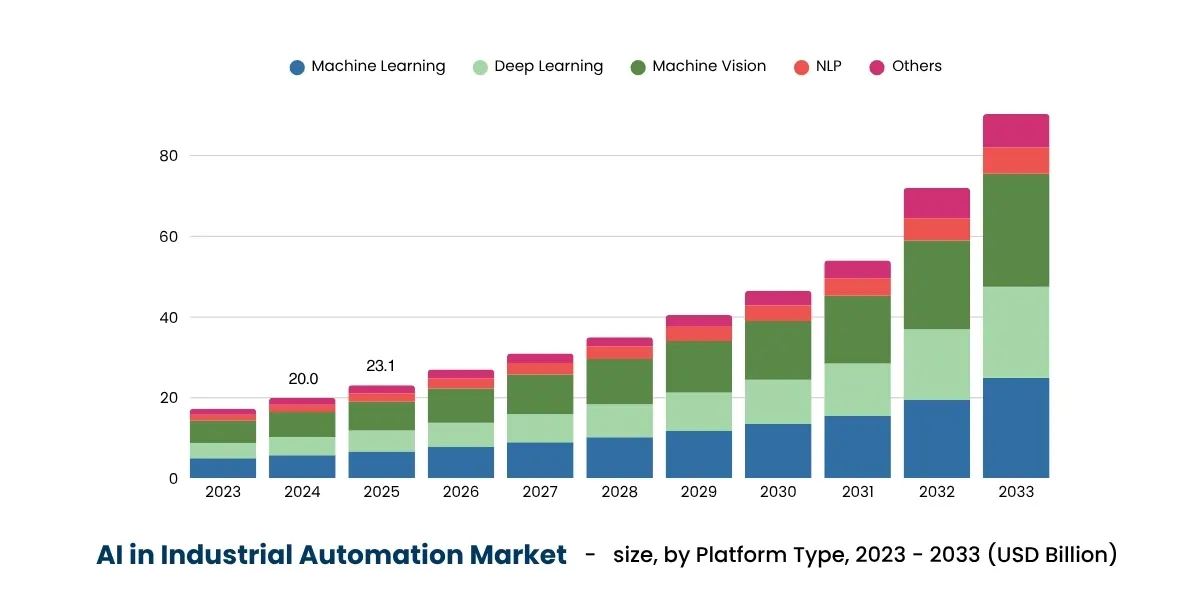
Source : Grandviewresearch
Every major business faces hundreds of processes on a daily basis. Order forms, compliance checks, client enrollment, inventory tracking, accounting reporting the list goes on, and most of these processes are done manually.
The issue? Manual procedures are inefficient, prone to mistakes, and costly to scale. With growing amounts of information and rising customer demands, it is impossible to compete using conventional methods.
Enterprise AI solutions become relevant at this point. AI systems operate differently from traditional software because they learn through data analysis while recognizing patterns and developing new abilities over time. The system provides automated task execution while improving the intelligence of each task.
The organizations that have implemented artificial intelligence into their business procedures already experience its benefits. The benefits include quicker processing times and decreased mistakes and reduced operational expenses and employees who can concentrate on important tasks instead of performing repetitive work. The distance between current companies and their use of traditional operational methods is increasing at a rapid pace.
Slow decision-making is one of the most common bottlenecks in enterprise environments. Data sits in silos. Reports take days to compile. By the time leadership has enough information to act, the opportunity has often passed.
AI decision making tools change this dynamic completely. They pull data from multiple sources in real time, analyze it instantly, and present actionable insights all without waiting for someone to build a spreadsheet.
To understand the difference clearly, here’s how traditional decision-making compares with AI driven decision making in a real-world scenario like supply chain management:
| Aspect | Traditional Approach | AI-Powered Approach |
|---|---|---|
| Data Review Frequency | Weekly or monthly | Continuous and real-time |
| Demand Forecasting | Historical sales data only | Combines market trends, weather, social signals, and past data |
| Risk Detection | Reactive after disruption happens | Proactive flagged before disruption occurs |
| Inventory Adjustments | Manual reorders based on set thresholds | Automated procurement triggered by predictive models |
| Response Time | Days to weeks | Minutes to hours |
The takeaway is simple. AI decision making doesn’t just speed things up it fundamentally improves the quality of decisions by removing guesswork and replacing it with data-backed intelligence.
Not every process benefits equally from AI. The biggest returns come from tasks that are high-volume, repetitive, rule-based, and data-heavy. AI for workflow automation excels in these areas because it handles them consistently, accurately, and at a scale that human teams simply can’t match.
Here are the key areas where the benefits of AI automation are most visible:
Finance and Accounting Automated invoice processing, fraud detection, and real-time financial forecasting reduce manual workload and minimize costly errors.
Human Resources AI-powered screening tools and chatbots handle high-volume recruitment efficiently, shortlisting candidates based on role-specific criteria in a fraction of the time.
Customer Service Natural language processing enables instant resolution of common queries, allowing human agents to focus on complex and sensitive interactions.
Manufacturing and Quality Control Computer vision and predictive maintenance algorithms catch defects early, reduce equipment downtime, and improve overall production quality.
IT Operations Automated incident detection, ticket routing, and AI automation for business, including self-healing systems, keep infrastructure stable with minimal manual oversight.
Each of these use cases directly supports AI for operational efficiency helping enterprises do more with fewer resources while maintaining high standards of quality and compliance.
The advantages of artificial intelligence in business operations extend beyond its ability to automate tasks and perform work at high speed. Here are the common benefits which organizations receive after they successfully implement enterprise artificial intelligence systems.
Unmatched Consistency AI applies the same standards to every transaction, every time. The regulated industries of healthcare and banking and insurance benefit from this consistency which decreases their compliance risks.
Deeper Insights Machine learning models uncover patterns hidden across millions of data points. These insights shape better pricing strategies, product decisions, and market positioning guided by a strong enterprise AI strategy that manual analysis would never catch.
Freed-Up Talent When teams stop spending hours on repetitive data entry and report generation, they redirect their energy toward creative problem-solving, strategic planning, and customer relationship building.
Scalable Cost Savings While the initial investment is real, enterprise AI solutions lower operational costs steadily over time by handling growing workloads without proportional increases in headcount.
Stronger Competitive Edge Companies that embed AI into their core operations respond faster to market shifts, deliver better customer experiences, and innovate more consistently than those still running on manual workflows.
Investing in AI without a clear strategy often leads to wasted budgets and stalled projects. The most successful enterprises follow a structured approach to AI investment strategies that ties every initiative back to a specific business outcome.
Detects all areas of operation that experience bottlenecks and show inefficiencies and result in high error rates. The best AI for enterprise projects starts by solving a specific, well-defined pain point rather than trying to transform everything at once.
Launch with a single, high-impact use case such as automating invoice approvals or improving demand forecasting. Once measurable results are in hand, use them to build the case for broader adoption.
AI models are only as good as the data behind them. Investing in clean, well-structured, and accessible data infrastructure is essential before scaling any AI for enterprises initiative.
Technology alone doesn’t drive transformation. Training employees to work alongside AI, building cross-functional teams, and creating a culture open to experimentation are critical to long-term success.
Define clear KPIs from the start. Track metrics like time saved, error reduction, cost impact, and customer satisfaction. Use these results to guide expansion into new departments and processes.
The enterprises investing in AI today aren’t just solving immediate problems. They are creating operational systems which will determine their future business success. The growing accessibility of AI technology will create greater distance between companies that adopt it early and those that enter the market later.
The question is no longer whether AI will transform business operations it already has. Your organization needs to decide between using AI for business automation as its primary transformation method or spending the next several years to achieve technological parity with competitors.
Do you want to create an artificial intelligence strategy that meets the needs of your business? Connect with Colan Infotech to get started with the right solutions for your business.
High-volume, repetitive, and data-driven tasks such as data entry, reporting, and workflow approvals benefit the most from AI automation.
Yes, AI systems unify data across departments, enabling better communication, faster alignment, and more informed cross-functional decisions.
AI identifies anomalies, predicts potential issues, and ensures consistent execution, reducing errors, fraud, and compliance risks.
Yes, AI solutions are scalable and can be tailored to fit both mid-sized and large enterprises based on their operational needs.
Real-time data allows AI systems to make instant decisions, adapt to changes, and continuously optimize business processes.
Join over 150,000+ subscribers who get our best digital insights, strategies and tips delivered straight to their inbox.