ChatGPT
 Grok
Grok
 Perplexity AI
ChatGPT
Grok
Perplexity AI
Perplexity AI
ChatGPT
Grok
Perplexity AI
4 min read | By Muhammed Irbaz | 18 September 2026 | Ecommerce
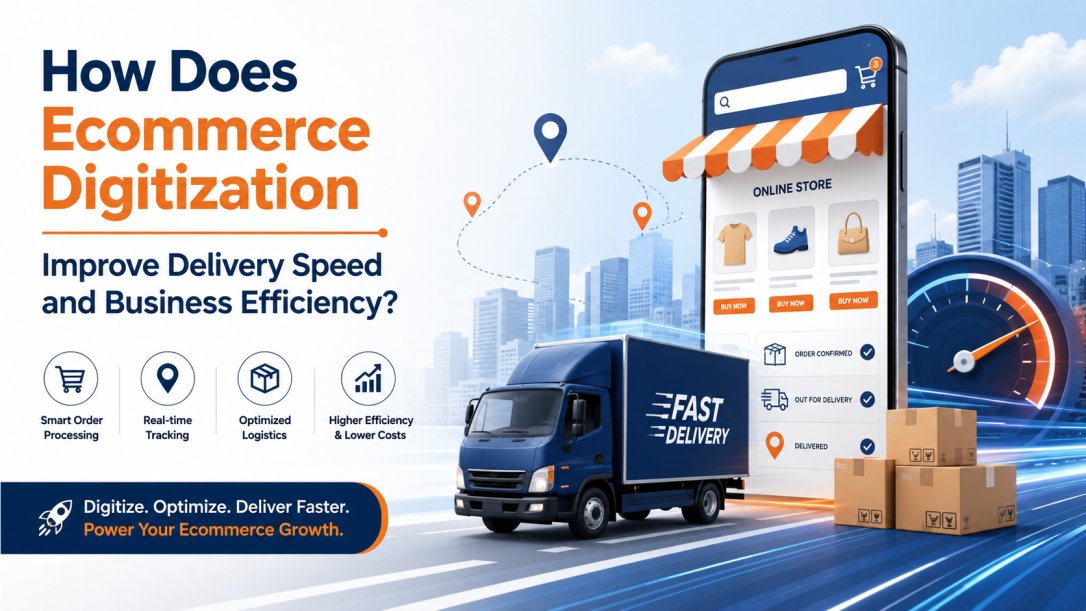
Most online stores don’t lose customers over price. They lose them over waiting. A shipment that takes three extra days, an order confirmation that never arrives, a warehouse team still checking stock on paper these small gaps add up, and customers notice. That’s the practical reason ecommerce digitization has become less of a buzzword and more of a survival tactic for retailers across the UAE, GCC, and other competitive markets. This piece looks at what digitization actually changes on the ground, not in theory, but in the day-to-day mechanics of getting an order from cart to doorstep.
Ecommerce digitization improves delivery speed by integrating order processing, inventory, and warehouse systems into a single automated workflow, reducing the delays that build up between checkout and dispatch. It boosts overall business efficiency by reducing manual errors, providing leadership with real-time visibility, and helping retailers scale without adding staff at the same rate as order volume increases.
● Slow shipping loses more customers than a slightly higher price ever will. That’s the real driver behind digitization, not the marketing buzz around it.
● Order processing, stock checks, warehouse work- these usually sit on separate tracks in most businesses. Once they’re connected, a lot of the small delays just disappear on their own.
● Fewer wrong shipments. Fewer stock mismatches. Less cleanup after an order’s already gone out. That’s roughly what a tighter fulfillment setup looks like day to day.
● The retailers who keep adjusting things year after year, instead of treating digitization like a box to check once, tend to find each next step a little smoother than the one before.
Source: Grandviewresearch
Companies invest in digitization mainly to eliminate the errors and delays that manual, spreadsheet-based processes create as order volume grows.
Spreadsheets break down once order volume grows. Someone forgets to update a stock count, two teams work off different numbers, and a customer ends up buying something that was never really in stock. This is the everyday reality that pushes companies toward ecommerce digital transformation not ambition, but friction.
What digitization typically brings to the table:
Fewer manual handoffs, since ecommerce process automation takes over tasks that used to require someone typing the same data into three systems
Systems that talk to each other, thanks to API integration linking storefronts, inventory, and shipping tools
Consistency across teams, because workflow automation removes the guesswork from repetitive steps
Cleaner reporting, since ecommerce operations management pulls scattered data into one place
None of this eliminates the need for people. It just frees them up to deal with problems that actually require judgment instead of retyping order numbers.
Businesses speed up delivery by connecting order processing, stock tracking, and warehouse handling into one automated system instead of running them separately.
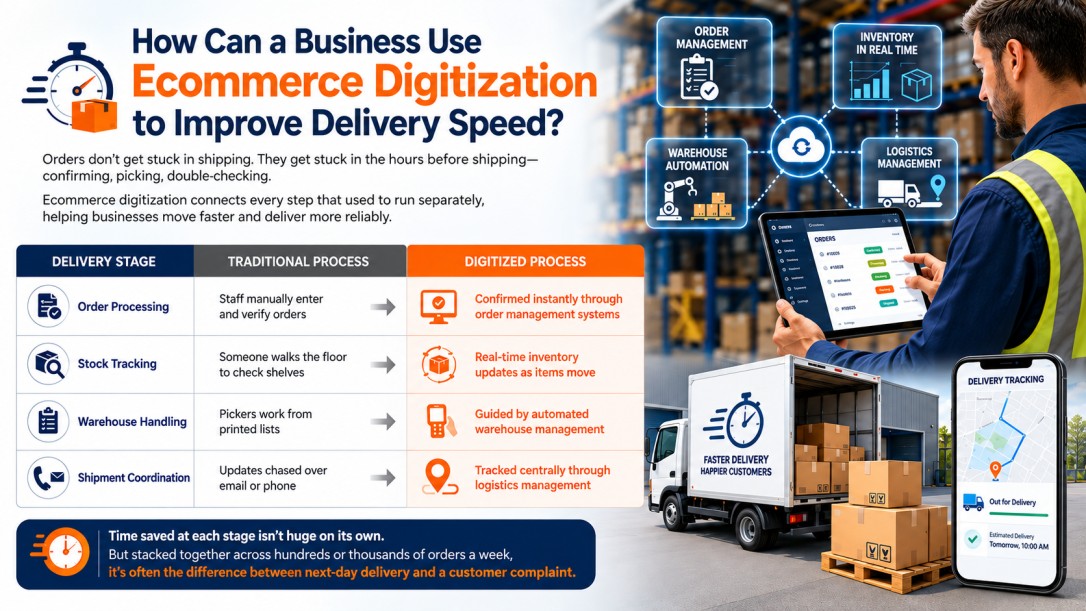
Ask most warehouse managers where orders get stuck, and they won’t say “shipping.” They’ll say the hours before shipping: the confirming, the picking, the double-checking. That’s where the real question of how ecommerce digitization improves delivery speed gets answered.
Businesses that have figured out how ecommerce automation reduces delivery time usually didn’t do it with one big software purchase. They connected the steps that used to run separately.
| Delivery Stage | Traditional Process | Digitized Process |
|---|---|---|
| Order Processing | Staff manually enter and verify orders | Confirmed instantly through order management systems |
| Stock Tracking | Someone walks the floor to check shelves | Real-time inventory updates as items move |
| Warehouse Handling | Pickers work from printed lists | Guided by automated warehouse management |
| Shipment Coordination | Updates chased over email or phone | Tracked centrally through logistics management |
The time saved at each stage isn’t huge on its own. But stacked together across hundreds or thousands of orders a week, it’s often the difference between next-day delivery and a customer complaint.
Digitization reduces stock mismatches, shipping errors, and disconnected vendor systems that typically slow down order fulfillment. Fulfillment is where good intentions meet reality. A business can have the best product in the world and still lose a customer because the wrong item shipped, or the right item was shipped late.
A few recurring problems and how digitization tends to address them:
Stock counts that don’t match reality fixed with ecommerce inventory management syncing numbers across every sales channel at once
Orders that go to the wrong address or include the wrong item reduced through structured ecommerce order management
Delays between “picked” and “packed” narrowed with fulfillment automation
Vendors, warehouses, and couriers operating on separate systems brought together through supply chain automation.
Individually, none of these fixes sound dramatic. Together, they change how predictable a business’s fulfillment process becomes, which matters more than most retailers expect until they experience it.
The biggest benefits include fewer order errors, more accurate delivery estimates, and the ability to scale without hiring at the same pace as growth.
The upside isn’t limited to shipping. Retailers who digitize their backend tend to notice changes in departments that had nothing directly to do with logistics: customer support tickets drop, finance reconciles faster, marketing gets better data to work with.
A closer look at where ecommerce efficiency shows up:
Order mistakes go down because systems catch errors before a human has to
Customers get delivery estimates that are actually accurate, not guessed
Growth doesn’t require hiring at the same pace as order volume
Leadership can see what’s happening across sales, stock, and shipping without waiting for a weekly report
Retailers dealing with seasonal spikes, holiday sales, and back-to-school rushes lean on ecommerce automation specifically because it absorbs volume that would otherwise overwhelm a manual team. Many pair this with ecommerce fulfillment solutions and ecommerce automation solutions so warehousing and last-mile delivery run through one connected setup rather than several disconnected vendors.
Long-term growth depends on treating digitization as an ongoing investment rather than a single rollout that eventually falls behind order volume.
A single software rollout doesn’t fix operations for good. Retailers who treat digitization as a one-time project usually find themselves back where they started within a year or two, once order volume outgrows whatever they installed.
Sustained growth tends to come from a few consistent habits:
Working with partners who offer real ecommerce software development, not generic templates
Bringing in ecommerce consulting services when internal teams can’t see their own blind spots
Choosing ecommerce technology solutions built to scale rather than ones that need replacing in two years
Committing to ongoing ecommerce digital transformation services instead of isolated tool purchases
Understanding why and how digital improvements improve an online retail business can’t be thought of as purely an IT challenge. It’s involved in business decision-making regarding budgetary allocations, staffing plans, and executive approaches to near-term development. Companies taking this approach would continue to leverage previously successful strategies in expanding their business rather than beginning each expansion from ground up.
Delivery speed and operational efficiency aren’t separate goals anymore; they’re the same goal viewed from two angles. Digitization works because it removes the friction between departments that used to operate in isolation, replacing guesswork with visibility and manual effort with automation where it actually helps.
No retailer needs to overhaul everything overnight. Even one improvement better inventory visibility, a connected order system, automated warehouse tracking tends to show results fast enough to justify the next step.
It means moving retail tasks order handling, stock checks, shipping updates off spreadsheets and phone calls and onto connected digital systems.
Manual systems break down as order volume grows, causing mismatched data and delays. Digitization keeps operations running smoothly even as demand increases.
Linking platforms through API integration cuts down on repetitive manual entry. Teams spend less time fixing mistakes and more time on tasks that need actual judgment.
Yes. Faster order processing and picking mean less time between checkout and dispatch. Across thousands of orders, those small savings become noticeable.
Inventory tracking, order processing, and warehouse handling are usually the priorities. These are also where manual delays tend to pile up the most.
It connects warehouses, suppliers, and couriers under one system instead of separate, disconnected tools. This cuts down on miscommunication and gives real-time visibility into stock and shipments.
Fewer order errors, more accurate delivery timelines, and the ability to handle growth without adding staff at the same pace. Leadership also gets cleaner data to work with, faster.
Join over 150,000+ subscribers who get our best digital insights, strategies and tips delivered straight to their inbox.