ChatGPT
 Grok
Grok
 Perplexity AI
ChatGPT
Grok
Perplexity AI
Perplexity AI
ChatGPT
Grok
Perplexity AI
4 min read | By Muhammed Irbaz | 02 July 2026 | Artificial Intelligence
Choosing the right AI development company comes down to checking technical expertise, industry experience, pricing transparency, and post-launch support, not just polished portfolios. The best approach is to run every shortlisted vendor through a structured checklist covering scalability, data security, and team composition, then validate the strongest candidates with a short pilot project before committing to a larger engagement.
1. Picking the right AI development company isn’t about who pitches best, it comes down to real expertise, honest pricing, and a track record that holds up under scrutiny.
2. A simple checklist covering security, scalability, and communication beats relying on gut feeling when comparing vendors.
3. Costs vary a lot depending on the engagement fixed-price for smaller projects, dedicated teams for ongoing work.
4. The best partners stick around after launch instead of disappearing once the invoice is paid.
Source: Grandviewresearch
An AI development company builds AI systems for businesses, chatbots, recommendation engines, fraud detection tools, and automation workflows ranging from small teams to large firms with hundreds of engineers.
What sets them apart from regular AI software development company vendors is the skill set involved. Beyond developers, they need people who understand data and how models learn, and most AI software development companies spend significant time cleaning and structuring data before training begins.
Many also act as AI consulting companies, first assessing whether AI is even the right solution before writing any code and a credible vendor will say so honestly, even when the answer is no.
The right AI development company is chosen by evaluating technical expertise, domain experience, security practices, and pricing transparency side by side, then confirming the fit with a small pilot project.
Selecting the right AI development partner determines how reliable, scalable, and cost-effective the final solution will be. With many agencies now claiming AI expertise, businesses need a clear way to separate genuine capability from marketing language.
| Factor | What to Look For |
|---|---|
| Technical expertise | Proven experience in relevant AI areas (ML, NLP, computer vision, or generative AI) and modern frameworks |
| Domain experience | Prior work in the client’s industry, given differing data and compliance needs |
| Portfolio | Verifiable past projects with measurable results, not vague claims |
| Data & security practices | Clear protocols for data privacy and regulatory compliance |
| Team composition | A mix of data scientists, ML engineers, and domain experts |
| Post-deployment support | A plan for monitoring, maintenance, and retraining after launch |
| Pricing transparency | Clear costs covering development, data prep, and iteration |
Most failed AI engagements don’t fail because of bad models, they fail because of bad data handoffs. A vendor’s first two weeks on a pilot project, specifically how they handle your existing data mess, predicts the outcome of the entire engagement far better than any case study can.
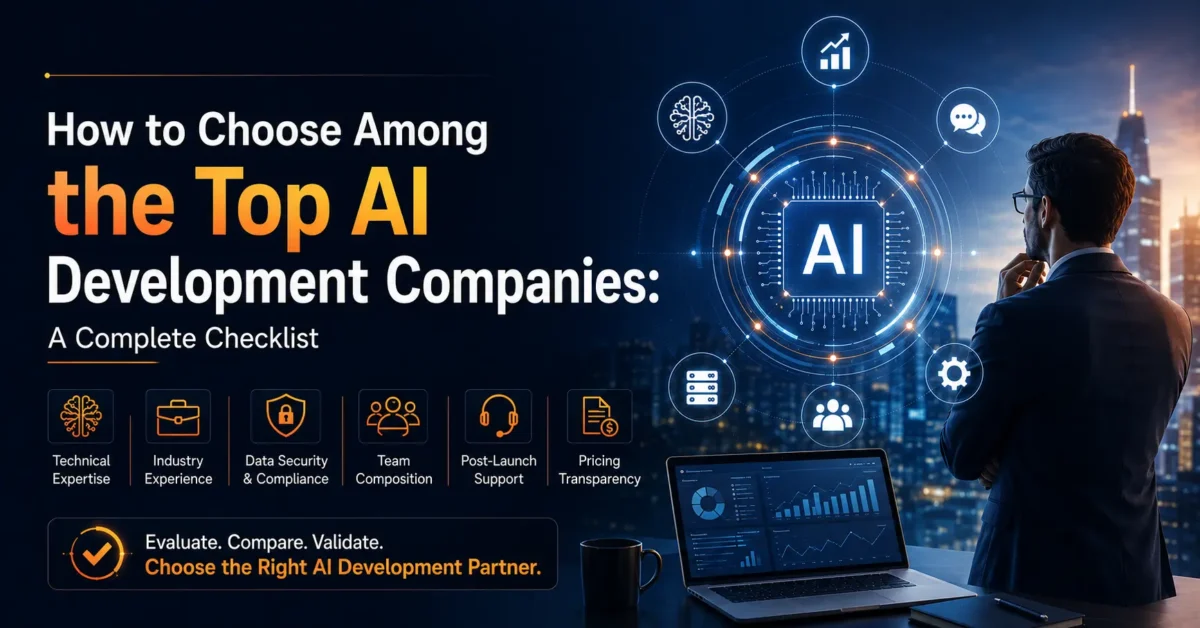
A reliable evaluation checklist covers technical expertise, industry experience, communication, scalability, security standards, post-launch support, and pricing transparency.
It helps to put everything on paper instead of relying on gut feeling alone. Here’s a rough checklist worth running through with every vendor you talk to:
| Evaluation Criteria | What to Check |
|---|---|
| Technical Expertise | Real hands-on experience in machine learning development, NLP, or computer vision not just buzzwords on a website |
| Industry Experience | Have they actually worked in your sector before finance, healthcare, retail, whatever applies |
| Communication | One point of contact, regular updates, no disappearing for two weeks mid-project |
| Scalability | Built on cloud-native, modular architecture so it grows with you |
| Security Standards | Encryption, compliance certifications, proper access controls |
| Post-Launch Support | Will they still answer your calls after the launch, or is that it |
| Pricing Transparency | A cost breakdown you can actually understand, no surprise invoices later |
When you’re comparing several leading AI development companies side by side, this kind of table makes it much easier to spot which one is all talk and which one actually has substance behind the pitch.
Businesses should verify client references, data ownership terms, the actual team composition, integration support, and change-management capability before signing any contract.
Before signing anything, it’s worth digging a bit deeper than the sales call:
1. Ask for client references and actually call them. Case studies on a website tell you what the company wants you to know.
2. Find out who owns the trained models and data once the project wraps up. This gets messy if it’s not in writing upfront.
3. Check who’s actually building your product. Is it the senior team you spoke to, or will the work get handed off to juniors?
4. Make sure they can handle AI consulting services with whatever systems you already have: CRMs, ERPs, old legacy software, all of it.
5. Ask how they handle the human side of things. Good business automation rollouts usually fail or succeed based on how well the internal team is trained, not the tech itself.
This matters even more for enterprise AI development companies, where one new system has to fit into a much bigger, messier web of existing departments and tools.
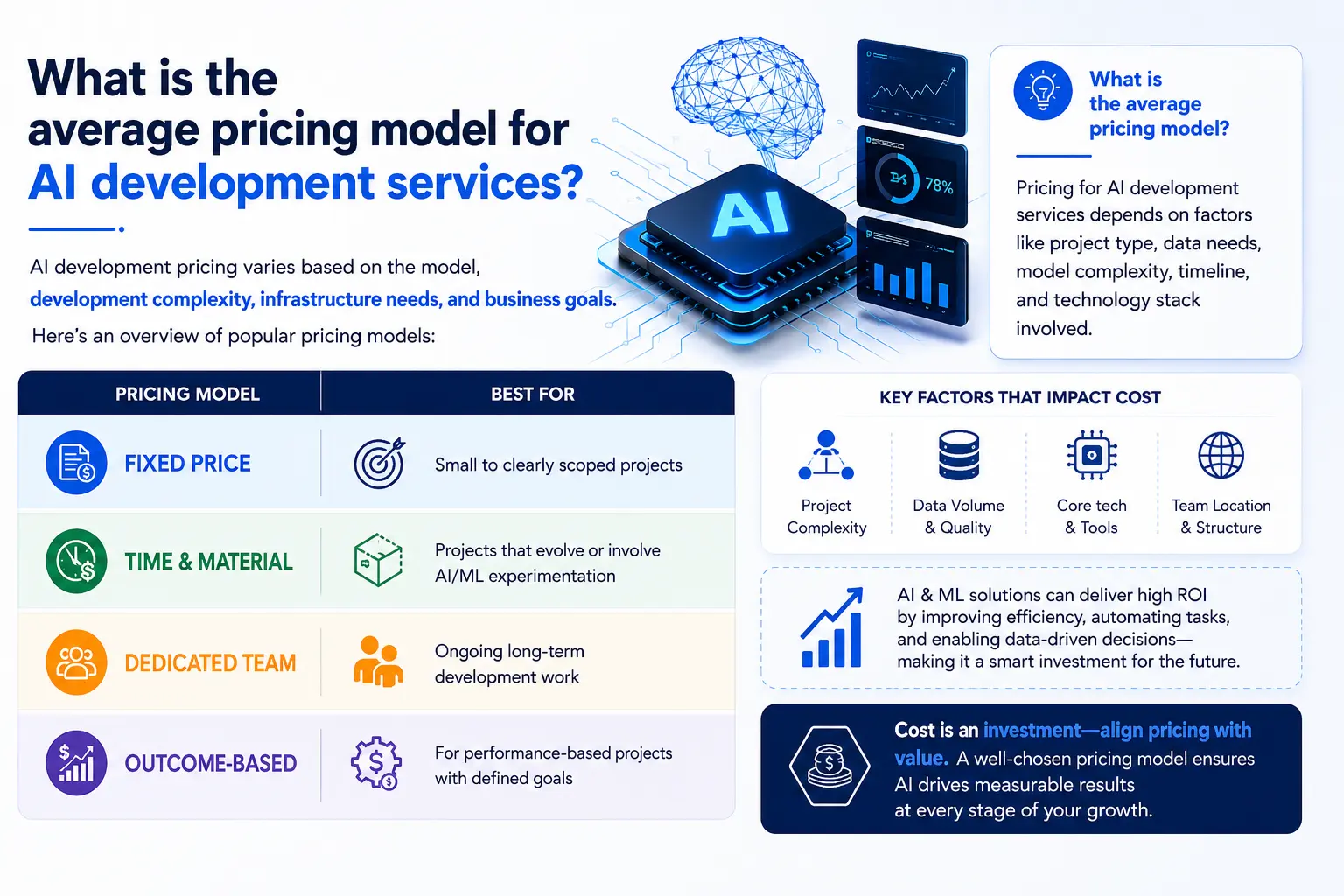
AI development pricing typically follows one of four models: fixed price, time and material, dedicated team, or outcome-based, depending on project scope and engagement length.
Honestly, there’s no single number anyone can give you here; pricing for AI development services swings a lot depending on the complexity of what you’re building, where the team is based, and how the engagement is structured. Most vendors stick to one of these models:
| Pricing Model | Best For |
|---|---|
| Fixed Price | Smaller, clearly scoped projects |
| Time & Material | Projects that evolve or involve a lot of research |
| Dedicated Team | Ongoing, long-term development work |
| Outcome-Based | Engagements tied to specific performance goals |
A lot of businesses dip their toes in with time-and-material pricing first, just to see how a vendor performs, before committing to a full dedicated team a common approach when exploring AI outsourcing for the first time. Costs climb noticeably once you get into generative AI development, mainly because of the compute power and the sheer volume of data these projects need.
Top AI development companies are best compared by specialization, startup versus enterprise readiness, innovation track record, and the strength of their post-launch support system.
Comparing top AI agent development companies against the bigger, more general-purpose vendors isn’t really about who has the flashier website. A few practical angles to think about:
● A firm that specializes purely in AI agent development will usually outperform a generalist on complex, agent-driven workflows. But if your needs span multiple use cases, broader custom AI development companies might give you more room to maneuver.
● Some vendors are built for speed and flexibility, ideal for AI development companies for startups working with tighter budgets and faster turnarounds. Others are set up specifically for top AI development companies for enterprises, where compliance and red tape slow everything down
● Pay attention to who’s actually publishing research or contributing to open-source work; that’s usually a decent signal of depth among the best generative AI development companies, beyond just marketing copy.
● A strong support system matters more than people expect. The better enterprise AI solutions providers keep dedicated teams around well after launch, especially for businesses mid-way through a larger digital transformation push.
At the end of the day, there’s no universal “best” company. It comes down to your budget, your timeline, and how ready your team actually is to work with AI day-to-day.
Finding the right fit among the best AI development companies isn’t about picking whoever has the most polished portfolio or the lowest quote. It comes down to actually checking their technical depth, being upfront about pricing, making sure the system can scale, and confirming they’ll be around for support later. Whether the goal is custom AI development, rolling out AI automation solutions, or just getting advice from one of the leading AI consulting firms out there, the right partner should feel less like a vendor and more like someone genuinely invested in the outcome. Run through the checklist above with every company on your shortlist, and the decision gets a lot less overwhelming.
The best companies vary by use case, but strong ones share proven AI project portfolio, clear pricing, and real industry experience. There’s no universal winner, only the right fit for a specific business.
Evaluate vendors on domain expertise, communication, scalability, and security practices. A structured checklist works better than judging on a sales pitch alone.
Enterprises should look for vendors experienced in complex integrations, compliance, and large-scale data handling. Firms offering dedicated, long-term support tend to suit enterprise needs best.
Pricing depends on the engagement model, with fixed-scope, hourly, and dedicated-team options each suited to different project needs. Costs vary based on complexity, team seniority, and how clearly the project requirements are defined upfront.
Services typically include AI consulting, custom development, system integration, and automation. Many also provide ongoing model fine-tuning and post-launch support.
A development company builds and deploys AI systems, while a consulting firm focuses on strategy. Many vendors today handle both roles together.
Join over 150,000+ subscribers who get our best digital insights, strategies and tips delivered straight to their inbox.