ChatGPT
 Grok
Grok
 Perplexity AI
ChatGPT
Grok
Perplexity AI
Perplexity AI
ChatGPT
Grok
Perplexity AI
4 min read | By Muhammed Irbaz | 07 April 2026 | Artificial Intelligence
AI has moved well past the pilot stage. In 2026, businesses are not experimenting with it, they are running enterprise AI platforms in production, across departments, at real scale. If you lead operations, IT, or digital strategy, the question is no longer whether to adopt AI. It is which tools, platforms, and architecture to build on and how to make the right call for your business.
This blog breaks it all down clearly.
The AI platform market was worth USD 14.21 billion in 2024 and is expected to reach USD 251.01 billion by 2033, growing rapidly each year.
Source: Grandviewresearch
The way businesses run has fundamentally changed. Manual workflows, siloed systems, and slow decision cycles are no longer competitive. AI in business operations is now a baseline requirement not a differentiator.
What has shifted in 2026 is the depth of integration. AI is no longer sitting on top of business processes. It is embedded inside them. From finance and HR to supply chain and customer service, teams expect AI to plan, execute, and adapt not just assist.
Unlike traditional automation scripts that break when conditions change, the best agentic platforms today interpret intent, plan tasks, choose the right tools, and adjust actions in real time making them far more suited to the complexity of real enterprise environments.
This shift is why AI for business automation has become a board-level priority across industries.
The right AI tools for enterprise are no longer standalone products. They are embedded into the workflows your teams use daily. Here are the tools making the biggest impact.
Microsoft Copilot Studio is one of the most widely adopted tools for enterprises running on Microsoft 365. It provides a low-code environment for building autonomous agents within the Microsoft 365 ecosystem, leveraging Power Platform and Entra ID for secure, identity-aware interactions enabling memory-enabled workflows that span SharePoint, Teams, Outlook, and external connectors via the Microsoft Graph API.
CrewAI and AutoGen are popular open-source frameworks for teams building custom multi agent ai systems from scratch. CrewAI supports role-based architecture, flexible LLM support, and an expanded integration layer that allows agents to trigger workflows via Gmail, Slack, Salesforce, and cloud services Moveworks making it well suited for complex, multi-step business processes.
Automation Anywhere’s AI Agent Studio combines RPA with modern agentic capabilities on a single platform. Its agentic architecture was built from the ground up not layered onto older automation frameworks enabling faster automation development and greater workflow resiliency compared to traditional approaches.
Generative ai for enterprise has also moved beyond content. In 2026, it powers contract analysis, code generation, compliance documentation, and customer resolution all driven by LLMs connected to business systems through structured agent workflows.
The best AI platforms for business are not just feature-rich, they integrate deeply with existing systems, scale reliably, and enforce governance without slowing teams down. Here are the leading enterprise AI platforms to know.
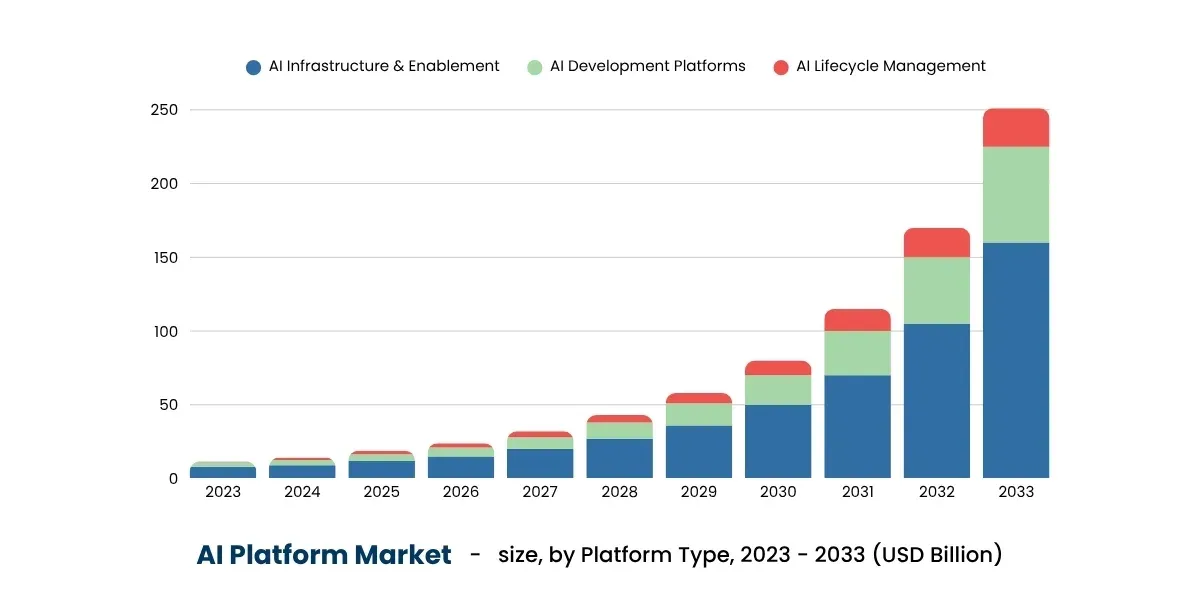
Source: Grandviewresearch
Microsoft Azure AI Services remains the most comprehensive cloud stack for large enterprises. Microsoft Azure ai services covers foundational models, agent orchestration, identity management, and compliance tooling all within a single ecosystem that most enterprise IT teams already trust and operate in.
Google Vertex AI Enterprise is a strong option for businesses running on Google Cloud. Google vertex ai enterprise provides access to Gemini models, agent builder tools, and enterprise-grade MLOps pipelines. Teams standardized on Google Cloud benefit from first-party monitoring for agent lifecycles, prebuilt plugins, and observability dashboards covering token usage, latency, errors, and tool calls.
Kore.ai is one of the strongest dedicated intelligent automation platforms for enterprises that want multi-agent orchestration without building from scratch. With advanced multi-agent orchestration, cloud and model-agnostic architecture, and a strong focus on AI governance, Kore.ai empowers organizations to deploy AI safely and responsibly at scale while driving lower total cost of ownership.
Getting the enterprise ai architecture right is just as important as picking the right platform. Poor architecture leads to slow deployments, broken integrations, and compliance blind spots.
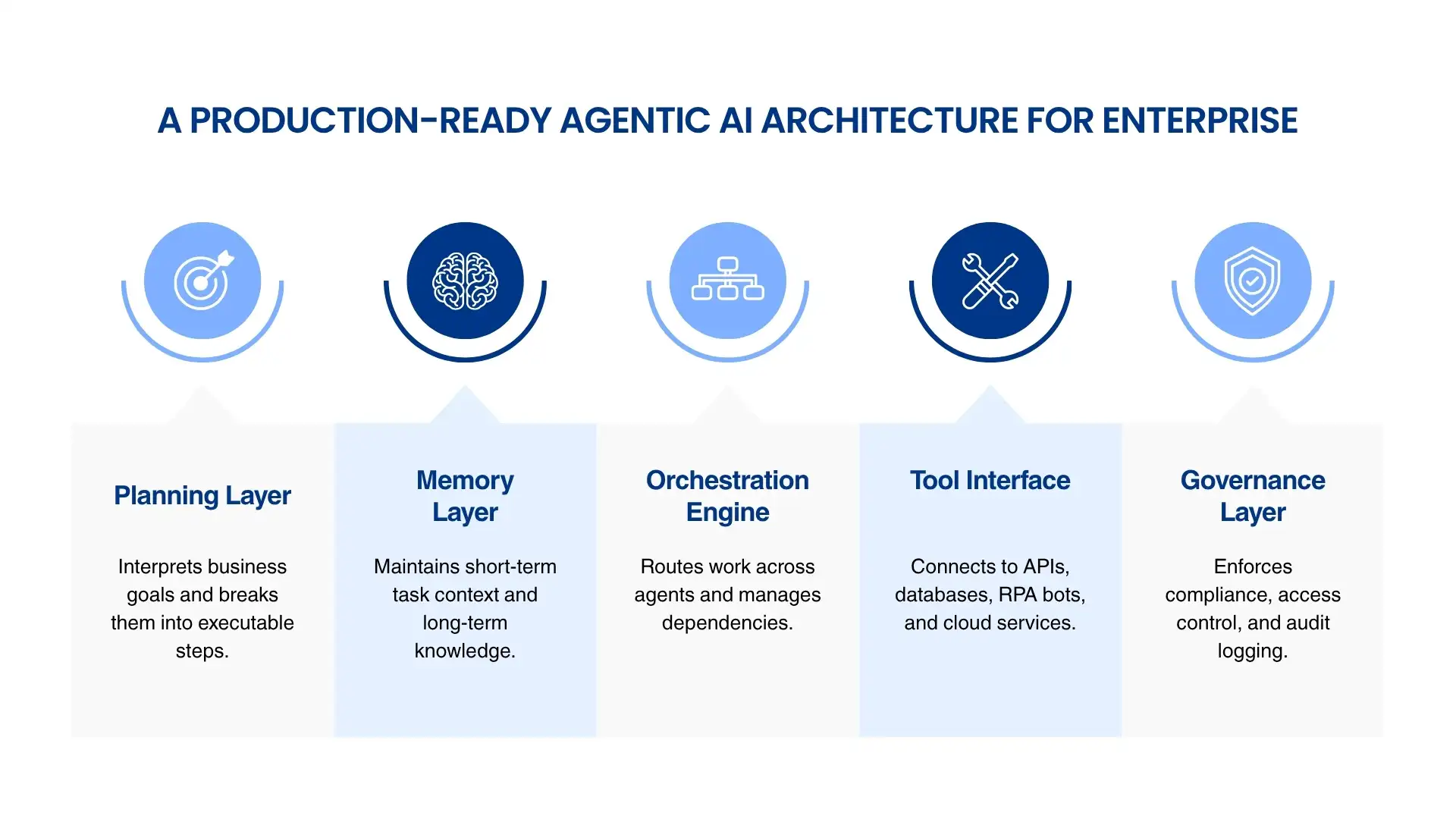
Agentic ai architecture is the dominant structural model in 2026. Best-in-class agentic platforms rely on modular, multi-agent architectures that combine planners, memory layers, orchestration engines, secure tool interfaces, and policy controllers allowing scalable autonomy while maintaining enterprise governance.
A production-ready agentic ai architecture for enterprise typically includes five layers:
Planning layer Interprets business goals and breaks them into executable steps
Memory layer Maintains short-term task context and long-term knowledge
Orchestration engine Routes work across agents and manages dependencies
Tool interface Connects to APIs, databases, RPA bots, and cloud services
Governance layer Enforces compliance, access control, and audit logging
Multi agent ai systems are one of the most important shifts in enterprise AI right now. Rather than relying on a single AI doing everything, businesses are deploying specialized agents that each handle a defined part of a larger workflow.
Agentic AI architectures use multiple specialized agents that collaborate, each focused on a slice of the problem, such as perception, reasoning, or taking action in a specific system while an orchestrator coordinates them toward a shared objective.
This structure maps naturally onto how enterprises already operate. Finance owns one process, HR owns another, IT manages a third. Multi-agent systems mirror that division of labor and route work intelligently across every layer.
The result is that ai for business automation stops feeling like a point solution and starts functioning as a connected, cross-system intelligence layer across the entire organization.
With so many enterprise ai platforms claiming to be agentic, it is easy to get lost in marketing language. Here is what actually matters when evaluating your options.
The platform should handle conditional logic, parallel tasks, and event triggers and adapt if one system fails mid-process rather than relying on a narrow set of prebuilt connectors.
Use these questions to guide your evaluation:
The right answer depends on your industry, existing infrastructure, and how mature your AI adoption already is. What matters most is that your platform and architecture are designed to grow together, not just get you started.
In 2026, enterprise AI success depends on three things, working together with the right tools embedded in your workflows, a platform that scales with your business, and an architecture designed for both autonomy and control.
Whether you are evaluating microsoft azure ai services, google vertex ai enterprise, or a purpose-built agentic solution, the winning approach stays the same: align your AI stack to real business processes and govern it from day one.
They analyse large datasets in real time and provide insights that help businesses make faster and more accurate decisions.
Yes, many platforms offer scalable solutions that allow small businesses to start small and expand as needed.
High-quality data ensures accurate predictions and better performance of AI models across business processes.
Most modern platforms provide APIs and connectors that allow integration with existing legacy systems.
Teams typically need a mix of data science, software development, and business strategy knowledge to use AI effectively.
Join over 150,000+ subscribers who get our best digital insights, strategies and tips delivered straight to their inbox.