ChatGPT
 Grok
Grok
 Perplexity AI
ChatGPT
Grok
Perplexity AI
Perplexity AI
ChatGPT
Grok
Perplexity AI

4 min read | By Nishali M | 01 December 2025 |
Source: Grandviewresearch
Edge AI is transforming data processing, moving intelligence directly to the point of creation. It provides for more local and real-time decision-making by smart devices and sensors, without complete reliance on the cloud. This removes latency, adds to security, and allows faster and more efficient operations across manufacturing, healthcare, and transportation sectors, making systems truly intelligent and responsive.
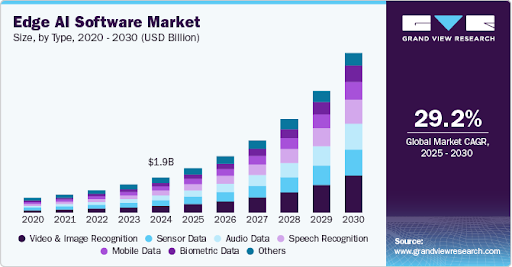
Source: Grandviewresearch
Edge AI means the deployment of the AI algorithms directly on a particular edge device-such as sensors, cameras, smartphones, robots, or industrial machines-rather than simply relying on the cloud infrastructure. In plain words, it means carrying out AI computations locally, closer to the source of data rather than transferring data back and forth to faraway servers.
It merges the AI models that can analyze, predict, and act in an instant.It enables the dependency on stable internet connectivity or high network architecture.
The training of these models is carried out in the cloud, after which they are deployed to edge devices, which are embedded with chips supporting on-device inference.Data Generation: IoT sensors, cameras, or machines generate raw data at the edge.Local Processing: Instead of sending this data to the cloud, it’s processed locally using AI algorithms embedded within the device.
Inference and Action: The device analyzes information and makes decisions in real-time, be it detecting an anomaly on a factory line or recognizing faces passing through a security camera.Cloud Sync: Aggregated data or summarized insights will then be passed to the cloud for deeper analysis or long-term storage.
Edge AI is already transforming industries through practical applications that rely on real-time AI and low-latency applications. Here are the real-world examples:
Embedded AI-powered cameras can detect anomalies, recognize faces, or read license plates in real time-all independent of the cloud.
In manufacturing, sensor data powered by Edge AI development can detect equipment failure before it happens to prevent unplanned downtime and optimize necessary maintenance.
This class of healthcare devices locally analyzes data of biometric measures for quick responses, such as irregular heart rhythms.
Autonomous vehicles rely heavily on low-latency AI for obstacle detection, navigation, and decision-making on the go.
smart shelves and checkout systems that can monitor inventory, improve customer experience, and offer real-time personalized recommendations.
| Aspect | Edge AI | Cloud AI |
|---|---|---|
| Location of Processing | Data processed locally on the device | Data processed in centralized cloud servers |
| Latency | Ultra-low latency | Higher latency due to data transfer |
| Scalability | Scaling requires more hardware and licensing, which becomes prohibitive and time-consuming. | Highly scalable. You configure your subscription tiers and can immediately add users or functionalities. |
| Connectivity Requirement | Works even offline | Requires constant internet connection |
| Data Privacy | High data stays on device | Lower data transmitted to cloud |
| Scalability | Limited by device hardware | Highly scalable in the cloud |
| Use Case | Real-time, localized AI, for example, independent systems | Heavy computation, large-scale analytics |
With edge AI, industries can conduct real-time processing with low latency while ensuring data privacy; thus, it has become indispensable in many sectors. Following is a rundown of major Edge AI applications across industries:
Factories are leveraging this to monitor machinery health, optimize energy consumption, and improve production quality. Instantly detects deviations and anomalies to undertake proactive maintenance at lower operational costs.
It powers traffic management systems, waste monitoring, and public safety solutions. IoT analytics from sensors and cameras enable city administrators to make quick, data-driven decisions.
These include customizing experiences, tracking consumer movements inside the store, and developing Edge AI for better supply chain management by retailers themselves. Real-time AI enables a store to adapt instantaneously to consumer behaviors.
Medical devices consistently monitor patients and, therefore, can diagnose and respond to emergencies a lot faster. Edge AI ensures the applications where every millisecond counts.
Edge Computing AI-powered device management systems increase route optimization, driver behavior monitoring, and predictive vehicle maintenance.
Most especially, industries seek Edge AI for its vast benefits that include speed, security, and scalability.
It operates instantly on the device, suitable for applications like autonomous vehicles, robotics, or industrial automation, where low latency is required.
Edge AI, through the local data retention mechanism, minimizes the risk of the data being hacked thus, the regulatory compliance for the privacy of the data is also further ensured.
The transfer of less data to the cloud results in lower organizational bandwidth costs and less storage cost, as edge analytics send only the analyzed insights, not the entire raw data streams.
The presence of reliable Internet or even its absence will not affect the operation and this is very much needed in various applications such as remote industrial sites and vehicles, and medical devices.
The development of Edge AI can easily be scaled up to an enormous number of devices. Each of the edge devices will be transformed into a smart node that is part of the disseminated network of the AI system and is capable of being customized for different applications.
The next frontier in intelligent computing is Edge AI, which involves pushing AI to the edge, enabling localized intelligence exactly where it is most needed. Businesses can achieve faster insights, protect data privacy, and build smarter, more resilient systems by marrying the capabilities of Edge Computing AI, embedded AI, and IoT AI.
As the world begins to move toward a decentralized AI ecosystem, development in Edge AI will unquestionably continue to empower industries, enrich user experiences, and redefine how machines and humans interact-literally pushing intelligence closer to the source of data.
Join over 150,000+ subscribers who get our best digital insights, strategies and tips delivered straight to their inbox.