ChatGPT
 Grok
Grok
 Perplexity AI
ChatGPT
Grok
Perplexity AI
Perplexity AI
ChatGPT
Grok
Perplexity AI
4 min read | By Admin | 02 April 2026 |
Online retail is moving faster than ever. Customer expectations are higher, competition is tighter, and the margin for operational error is shrinking. Businesses still relying on manual processes and guesswork are already falling behind. The ones pulling ahead are those investing in ai in ecommerce not as a future plan, but as an active part of how they run today.
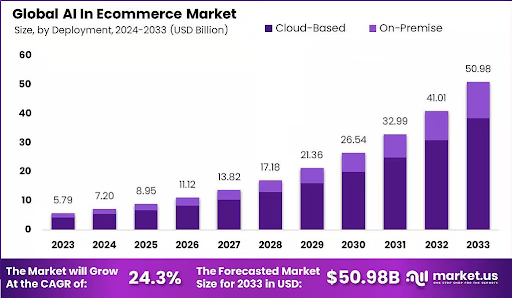
In 2025, AI moved from experimentation to infrastructure, with 89% of retailers confirming that AI-based solutions directly increased their revenue. In 2026, that number is only growing. This blog breaks down exactly how ai powered ecommerce platform technology is transforming both the sales side and the operations side of online retail.
The biggest shift AI has brought to ecommerce is the ability to treat every shopper as an individual not a segment. Advanced neural networks now analyse past behaviour, browsing patterns, and purchase timelines to anticipate intent and recommend products proactively.
This level of personalized shopping experience was simply not possible at scale before AI. Today it is a baseline expectation.
Personalized product recommendations sit at the heart of this shift. AI-driven recommendations have the potential to increase revenue by up to 300%, boost conversions by 150%, and raise average order value by 50%.
On an ecommerce site, AI chatbots guide shoppers through products, answer questions instantly, and handle order tracking without a human agent involved.
AI inventory management and supply chain by making operations faster, smarter, and more accurate. It uses real-time data to track stock levels across multiple locations, reducing errors from manual checks.
In supply chains, AI optimizes routes, selects efficient carriers, and reduces delivery delays.
Rather than reacting to what has already sold, demand forecasting AI predicts what is about to sell and that changes everything about how a business plans.
Predictive analytics in ecommerce feeds decisions across purchasing, logistics, marketing, and pricing.
Understanding your customers used to mean looking at last month’s data and making educated guesses. AI driven customer insights have made that approach obsolete.
AI now analyses search queries, browsing behaviour, purchase history, and real-time interactions simultaneously surfacing patterns that no human analyst could catch manually. These insights tell you not just what customers bought, but what they were looking for, where they dropped off, and what would have kept them moving toward checkout.
This intelligence feeds directly into ecommerce conversion rate optimization. When the right product appears at the right moment, when content adapts to individual behaviour, and when the checkout path removes every unnecessary step conversion rates improve measurably. Companies using AI-driven personalisation earn 40% more revenue than those without it.
The insight loop is also self-reinforcing. The more customers interact, the smarter the system becomes meaning recommendations sharpen, experiences improve, and conversions keep climbing over time without additional manual effort.
The gap between AI in ecommerce businesses and those still running on traditional workflows is widening every quarter. Retailers with AI capabilities saw 14.2% sales growth between 2023 and 2024 compared to just 6.9% for those without.
From building a personalized shopping experience to streamlining automated order fulfillment, from demand forecasting ai to ai in supply chain management every part of the ecommerce operation improves when AI becomes part of the workflow. The question is no longer whether to adopt AI. It is how quickly you can move before the gap becomes impossible to close.
AI minimizes excess stock by accurately predicting demand and aligning inventory levels with real-time sales data.
Yes, AI tools are scalable and allow small businesses to automate inventory tracking and logistics.
AI analyses supplier performance and delivery timelines to improve coordination.
AI optimizes warehouse operations and reduces processing time.
Yes, AI synchronizes inventory across platforms ensuring accurate stock levels.
Join over 150,000+ subscribers who get our best digital insights, strategies and tips delivered straight to their inbox.