The AI agents market is set to surge from USD 7.84 billion in 2025 to USD 52.62 billion by 2030, reflecting a strong 46.3% CAGR.
AI agents make it possible for enterprises to automate decision making and execution, and not just analytics. They are fully compatible with existing business workflows and work with little manual supervision. It allows CIOs to explore monetizable business use cases and attain ROI in 90 days.
AI agents are revolutionizing the way businesses operate because these tools are no longer limited to offering insights but can also perform independently without the need for supervision. Unlike other AI models that are much more traditional,
AI agents are capable of self-action, decision-making within predefined bounds, and can directly be integrated with workflows. For CIOs who are eager to demonstrate business value results, AI agents use cases can provide a one-of-a-kind chance to implement projects and achieve these results within a timeframe of 90 days.
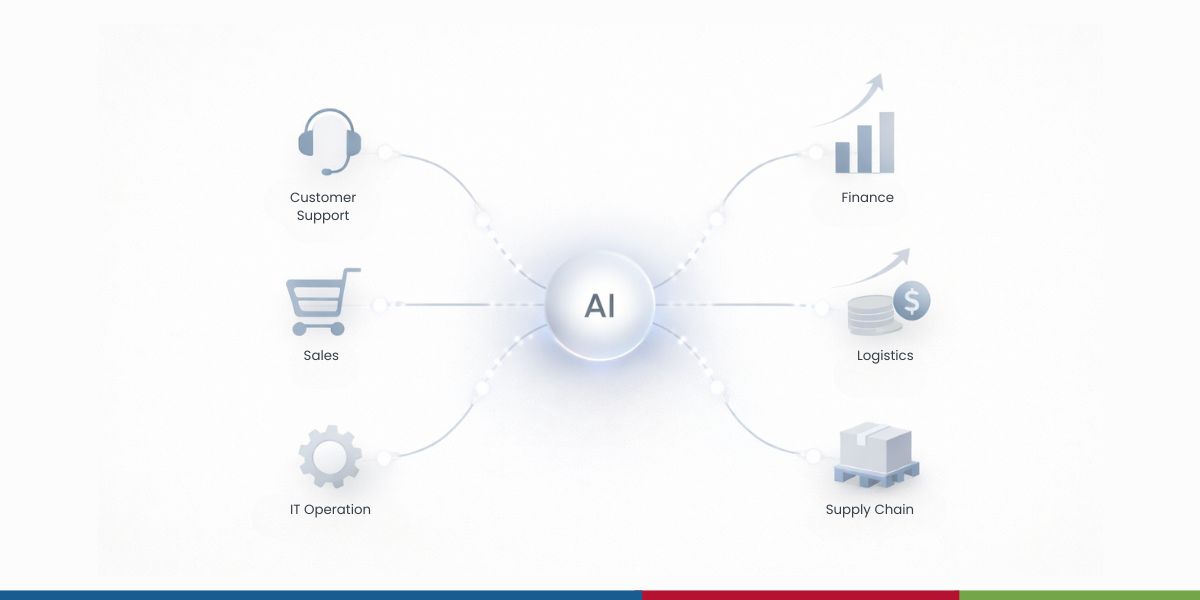
Some of the applications of AI, where there is direct monetization potential, involve optimizing customer services, intelligent sales prediction models, accounting and expense management, IT service management, and forecast models for determining demands and managing inventories. Enterprises find it possible to quickly roll out pilots with AI applications and measure the effectiveness of those applications since they rely on pre-built AI platforms and utilize data sets already available to them. As a result of AI agents for business, CIOs find it easy to achieve quick wins and make AI adoption successful.
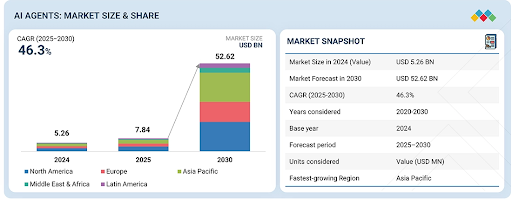
Source: Marketsandmarkets
How CIOs Can Obtain ROI on AI Within 90 Days?
The CIO can get ROI on AI in 90 days by identifying and executing on a set of highly defined, revenue-driven applications rather than projects aimed at business transformation. The quickest returns on investment for ROI on AI relate to automated applications like customer support, invoice receipt, sales forecasts, or IT service processes.
Leveraging this interest with the use of existing data and cloud platforms along with pre-trained models for AI, organizations can skip the long build process and go straight to pilots. Goals for the project must be identified from the very first day-cost savings, reduced cycle time, or incremental revenue. Cross-domain teams and rapid experimentation with weekly feedback on performance would aid in the refinement of the outcome. When AI is used for an identifiable task for the organization with measurable outcomes, the ROI appears in the first quarter itself.
Which 5 Monetizable AI Use Cases Can CIOs Pilot within 90 Days?
It also ensures that use cases suited for CIOs with an objective of providing AI Return on Investment within 90 days are focused on addressing short-term business issues with financial results. Here are examples of monetizable AI projects in various domains, including those suited for IT and technology industries.
AI-Powered Customer Support Automation
AI can itself classify and route customer inquiries, as well as reply independently through chat, mail, and voice interactions. With AI agents for customer support, it becomes easy to decrease ticket volumes and agent work, along with an improvement in response times and customer satisfaction. Cost savings and improved service levels are seen within a matter of weeks of implementation.
Intelligent Sales Forecasting & Lead Scoring
AI continues to favor high intent leads through the assessment of sales data, consumer behavior, and market trends. As a result, the optimized sales pipeline enables sales professionals to target the areas of high conversion probability, thus positively impacting the win rate, velocity, and revenue prediction.
Automatic Invoicing & Expense Reporting
Extracting, verifying, and processing invoices and expense claims for payment can now be done automatically with the help of AI without the intervention of human beings. This will significantly minimize the occurrence of human errors and delays associated with the process. Invoices can also be processed in a manner that will significantly minimize associated operational expenses.
IT Service Desk Copilots
The role of artificial intelligence involves monitoring IT systems, initiating alerts, monetizing AI agents by aiding with normal maintenance, managing response to incidents, and supporting cyber security monitoring. The mean time to resolve reduces, and the productivity level of employees increases.
Demand Forecasting & Inventory Optimization
Artificial intelligence-based models are able to forecast the demand with a much more accurate scale of prediction, which takes into consideration the past tendencies along with the latest data. Companies are able to reduce shortages as well as overstocked products, thereby resulting in improved cash flow. The effect of which is immediately seen from the financial standpoint with regards to better margins and avoidance of wastage.
What is The Fastest Way to Pilot AI in the Enterprise?
Bringing AI to an enterprise can be intimidating, but the best way to prove its worth is to complete high-impact pilots. With strong AI data readiness in place, it is important to note that it helps an organization quickly prove the effectiveness of AI by accomplishing small and measurable projects.
Look for high-impact and low-risk use cases:
Start the process for analyzing the use cases for which it is possible for the AI technology to address high-impact issues, boost efficiency and minimize costs related to its operations, or improve the customer experience.
Leverage Existing AI Tools and Platforms:
Rather than building models on their own, leveraging existing AI tools and platforms will help enable the deployment of models without having to worry about the underlying infrastructure.
Assemble the pilot team:
This should involve representatives from the information technology and data science sides of the business, and key stakeholders. A strong team provides clarity regarding the feasibility, priorities, and change management requirements.
Control Experiment:
Testing the integration of the AI solution in a controlled environment or in a department. It would be possible to observe and correct in the controlled environment itself so as not to disrupt the enterprise with the integration of AI solutions.
Result measurement and quick iteration:
Measurement of results, user opinions, and business results can then be used to optimize AI models and processes with a higher degree of confidence in the approach because of what has now been discovered.
Scale successful pilots enterprise-wide:
In cases where the proof-of-concept succeeds, enterprisewide deployment of the solution should follow to maximize ROI and prove the ROI of AI agents in enterprise as a strategic enabler, not merely some isolated experiment.
Source: Prolifics
How are companies unlocking AI from vision to delivery?
Enterprises are swiftly translating AI vision into action and actual applications of AI across the enterprise through adoption of a phased approach that highlights experimentation, alignment, and results. Rather than implementing AI solutions across the enterprise simultaneously, an enterprise embarks on small pilot projects that help resolve some key business challenges.
Agile methodologies are usually adopted by teams because they allow for the development, testing, and improvement phases to be executed efficiently, especially when implementing workflow automation AI to streamline repetitive processes. In addition, pre-built AI platforms and cloud infrastructure are used by firms as a means of speeding up deployment and simplifying technical complexities. In essence, by measuring and scaling their successes, AI projects help in ensuring business value is attained by translating business ideas into solutions.
Which types of tasks, within an organization, can be conducted by AI agents independently?
| Category |
Tasks AI Agents Can Handle Autonomously |
| Administrative & Back-Office Jobs |
AI models are capable of performing tasks such as data entry and document processing, generating reports, and managing back-office functions. |
| Customer-facing activities |
Chat operations, handling emails, offering recommendations, and managing appointments to improve response time and customer satisfaction. |
| IT & Operations Tasks |
Monitoring IT systems, initiating alerts, maintenance activities, incident response, and cyber security monitoring. |
| Sales and Marketing Tasks |
Lead analysis, customer behavior tracking, targeted marketing, follow-ups, and demo scheduling. |
| Supply Chain & Logistics Tasks |
Inventory monitoring, demand forecasting, procurement optimization, and logistics management. |
How CIOs Can Demonstrate the Worth of AI This Quarter?
CIOs should quickly prove the value of AI by aligning with projects where there is a direct positive business outcome over an accelerated period of time. The most important thing here is to look for projects that could easily be accomplished in a matter of weeks and have direct positive results in the form of revenue, cost, or efficiency improvements.
Leverage the existing AI tools and infrastructure, including enterprise AI agents, to save on development time. Small pilot projects can be conducted, and based on those results, CIOs can gain support and confidence for overall strategic initiatives. This will help CIOs prove their success and the subsequent payback on AI initiatives.
To Wrap Up
Artificial intelligence agents are not something out of a sci-fi movie anymore. They are actionable solutions ready for enterprise AI automation. By identifying the right use cases, CIOs can implement pilots that automate certain tasks, offer efficiency, or create ROI over a period of 90 days.
To achieve success, it is essential to start small by utilizing existing AI platforms, performing controlled experiments, and piloting to scale what has been proven. By showing quick wins and results, enterprises can move from AI idea to execution, thereby demonstrating that AI is more than an investment in technology; it is also a key enabler.
Most Frequently Asked Question
1. Must AI systems undergo fundamental changes?
The AI agents can be designed so that they can work together with the current systems of the enterprise through the use of API.
2. Are AI agents safe to use in business?
Enterprise AI assistants operate within very tight parameters regarding security, regulatory compliance, and controls over data access.
3. Need Human Observation for AI Agents?
No, it is autonomous for specific tasks and involves the human only for exception and optimization purposes.
4. Can Mid-sized Firms Implement AI Agents?
Yes. It is easy to deploy the AI agents within mid-sized businesses by means of cloud and pre-built AI platforms.
5. In what ways are AI agents unlike traditional automation?
AI technology is learned by experience and is adaptive, contrary to rule-based automated technology that is inflexible and script-driven.
6. What are the necessary skills for AI agent management?
Teams require process knowledge and basic literacy in data, not advanced knowledge in AI or data science.
 ChatGPT
 Grok
Grok
 Perplexity AI