ChatGPT
 Grok
Grok
 Perplexity AI
ChatGPT
Grok
Perplexity AI
Perplexity AI
ChatGPT
Grok
Perplexity AI
4 min read | By Muhammed Irbaz | 08 July 2026 | Ecommerce
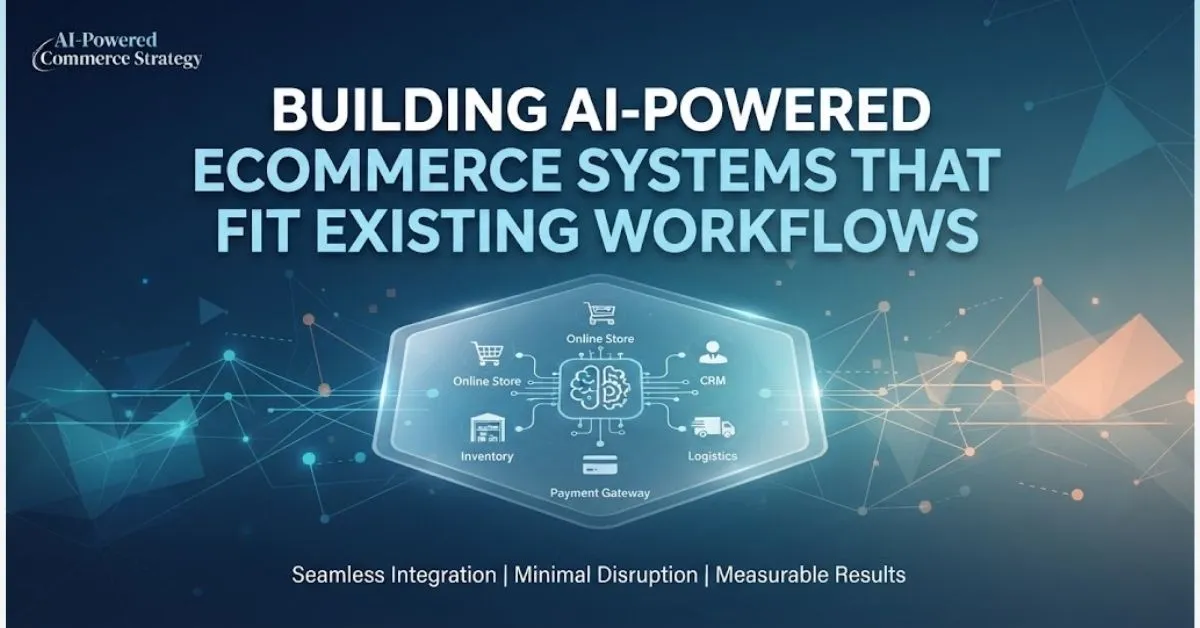
Most eCommerce businesses don’t struggle with finding AI tools; they struggle with making those tools work inside systems that already exist. Legacy platforms, established workflows, and team habits don’t disappear the moment new technology arrives. That gap between what AI promises and what operations can actually absorb is where most implementations stall. AI-powered ecommerce works best when it is built around existing processes, not dropped on top of them.
● AI-powered ecommerce works best when connected to existing CRM, inventory, and payment systems through APIs, not by overhauling them entirely.
● Auditing workflows and piloting one high-impact area first prevents the friction that causes most AI implementations to stall.
● Clean, well-structured data is the foundation for accurate forecasting, fraud detection, and personalization. Poor data leads directly to unreliable automation.
● Results like faster service and fewer errors appear early, while scalability and stronger customer retention build gradually as systems mature.
Source: marketresearchfuture
The eCommerce industry is moving fast, and many businesses still running manual processes are looking for a way to keep up without starting over. AI has become central to that shift, but the real challenge most teams face isn’t finding the right tool, it’s using AI without disrupting the systems and workflows already in place. This guide covers the concepts, the steps, and the common pitfalls involved in integrating AI ecommerce with existing workflows, so smart systems support what’s already working instead of replacing it.
An AI-powered ecommerce platform uses artificial intelligence to automate tasks, personalize shopping experiences, and optimize business operations. It helps businesses increase efficiency, improve customer satisfaction, and drive higher sales.
In practice, AI-powered ecommerce is not a single feature but a quiet intelligence layer operating in the background. It analyzes how customers browse, what they have purchased previously, changing inventory levels, and transaction patterns, then turns that information into decisions that would otherwise require constant manual effort. Retailers use it for demand forecasting, fraud detection, dynamic pricing, and customer segmentation. What connects these capabilities is the system’s ability to recognize real-time patterns and respond almost instantly, enabling faster and more informed decisions than manual processes can realistically achieve.
That’s the core distinction worth remembering throughout this guide. AI in ecommerce isn’t a single tool or feature; it’s a pattern-to-decision layer that sits on top of an existing ecommerce platform. The next section explores where this layer delivers the greatest business value.This shift from manual judgment to automated pattern recognition is part of a much larger move across industries toward AI for business automation.
AI fits best in ecommerce operations that rely on speed, personalization, and automation, such as product recommendations, customer support, inventory management, and order processing. It helps businesses reduce manual work while delivering a faster, more personalized shopping experience.
Not every part of an online business benefits equally from automation. Identifying the right entry points is essential before attempting ecommerce digital transformation at scale.
| Operational Area | AI Application | Business Impact |
|---|---|---|
| Customer Service | Chatbots, virtual assistants | Faster response times |
| Inventory Management | Demand forecasting models | Reduced waste and stockouts |
| Marketing | Personalization engines | Higher conversion rates |
| Search Functionality | Intelligent search algorithms | Improved product discovery |
| Order Fulfillment | Predictive logistics | Quicker delivery times |
| Pricing Strategy | Dynamic pricing tools | Competitive market positioning |
Among these, search functionality deserves special attention. A lot of consumers abandon a site if they are unable to find what they’re searching for. Incorporating the most powerful artificial intelligence-powered ecommerce search solutions enables shoppers to discover products quicker via natural language searches, visual search and predictive search auto-completion, which directly enhances conversion rates and customer satisfaction. Search performance also depends on the ecommerce platform a store is built on. Modern platforms with AI-powered search, predictive autocomplete, and flexible integration options help shoppers discover products faster and improve conversion rates.
This is precisely where ecommerce automation builds its strongest business case by reducing manual dependency in high-volume areas while keeping the customer experience consistent and fast.
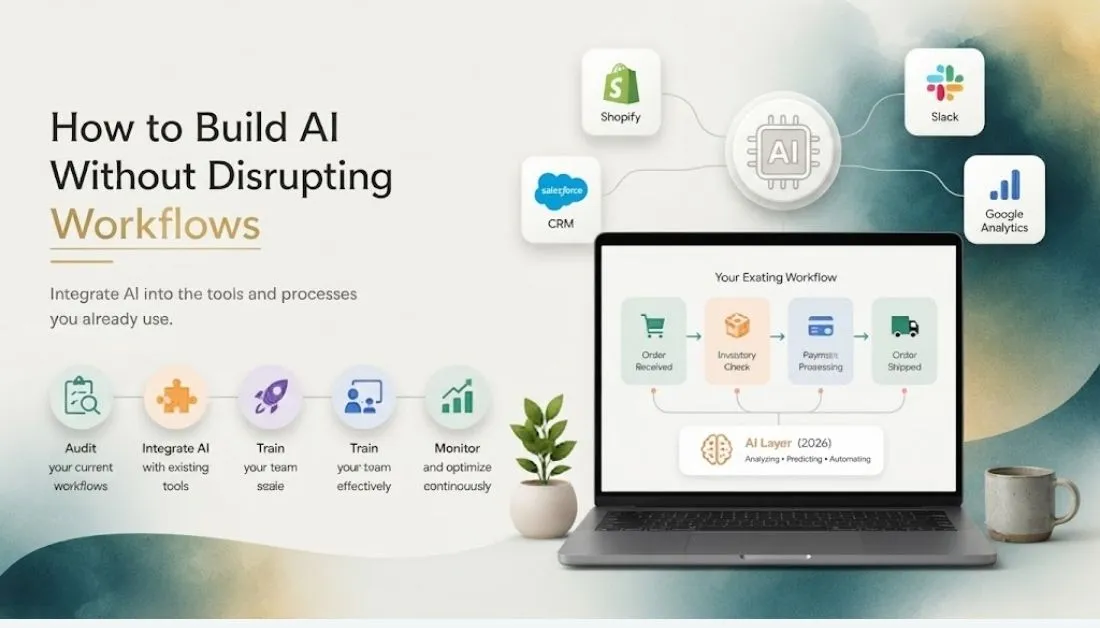
Building AI without disrupting workflows starts by integrating it into the tools and processes the team already uses instead of replacing them. Begin with small, high-impact use cases, test performance, and scale gradually based on real business needs.
This is often the most overlooked part of the process. Many enterprises rush into AI business process automation without first mapping their existing operations, leading to friction between new tools and legacy systems.
A structured approach tends to work best:
1. Audit current workflows to identify repetitive, time-consuming tasks suitable for automation
2. Choose modular AI tools that integrate with existing software rather than replacing it entirely
3. Pilot test on a small scale before rolling out company-wide
4. Train staff on how new systems interact with daily operations
5. Monitor performance metrics continuously and adjust as needed
The goal of integrating AI with existing ecommerce workflows should be seamless collaboration, not disruption. Rather than replacing familiar processes, AI should build on what’s already working. For enterprise companies running AI-driven systems, it’s essential that departments, vendors, and AI – powered ecommerce platforms stay in sync throughout the transition.
Ecommerce integration also has a key part to play here. New AI tools can integrate with legacy systems such as customer relationship management (CRM), payment gateways, and inventory systems through APIs, middleware, and cloud-based connectors, without the need for a complete overhaul of the infrastructure. For a deeper look at how autonomous systems execute these integrations, see AI Agent Development in 2026: The Complete Enterprise Guide.
AI adoption often involves challenges like poor data quality, integration with existing systems, high implementation costs, and employee resistance to change. Success depends on careful planning, the right expertise, and a clear business strategy.
While AI holds great promise for the ecommerce industry, there are also potential challenges to consider. Common challenges include:
AI systems depend entirely on clean, well-structured data. Poor data hygiene leads directly to flawed predictions, unreliable automation, and outcomes that create more operational problems than they solve.
This is real and consistently underestimated. When ecommerce process automation starts handling tasks that people have owned for years, friction is natural. Clear communication about what changes, what stays the same, and what new skills are needed makes the transition noticeably smoother for everyone involved.
Planning a budget can be challenging because costs vary based on several factors, including business size, existing systems, and the complexity of the chosen solution. Instead of committing to a fixed budget upfront, businesses should invest in phases by starting with small pilot projects before moving to a full-scale rollout. This approach reduces risk and allows teams to evaluate the return on investment before making larger financial commitments.
Security and compliance concerns are especially critical for businesses storing sensitive customer payment information. When adopting a new enterprise ecommerce platform, vendor selection plays a decisive role in maintaining data protection standards. See how enterprises evaluate platforms and vendor options, The Key AI Tools, Platforms, and Architectures Powering Enterprise Applications in 2026.
After adding AI, businesses can automate repetitive tasks, improve decision-making, and deliver faster, more personalized customer experiences. Over time, this often leads to higher productivity, lower operational costs, and better business outcomes.
With proper implementation, ecommerce workflow automation should provide tangible benefits across a number of business verticals. Customers tend to be more satisfied when service is faster and product suggestions feel more relevant. Automating repetitive manual tasks also frees up employee time to focus on strategic work, improving overall operational efficiency.
In addition, intelligent automation reduces the risk of human error in various processes, including order entry and inventory control, further enhancing customer trust and confidence in the fulfillment process. With time, companies that develop AI-driven ecommerce systems intentionally achieve better customer retention as customers will have a steady motive to return to the system because of the tailored activities they offer.
Scalability is where the long-term value lies. As AI-powered business solutions mature within an organization, they naturally expand into other departments, product lines, and markets, building a foundation for continued growth rather than functioning as a one-time upgrade.
The most sustainable AI implementations are not the most aggressive ones, they are the most deliberate. Start where the friction is real, prove the value, and scale from there.
Building systems that support current workflows takes time, careful planning, and a fair amount of trial and error before scaling up. Companies that treat this transition as a strategic process tend to land in a much better place than those automating just for the sake of automating.The assumption that AI adoption requires tearing everything down and starting over doesn’t hold up. Businesses making the most progress identify one operational challenge, solve it well, and expand from there.
AI-powered ecommerce tends to grow alongside a business rather than racing ahead of it, so what works for a mid-sized retailer today can look nothing like what works two years later. Picking one problem, solving it properly, and letting the results shape the next move that kind of patience is usually what separates sustainable growth from an expensive experiment.
AI is used for demand forecasting, fraud detection, dynamic pricing, and customer segmentation across retail operations. Each use case relies on real-time data patterns to replace manual, reactive decision-making.
The first step is auditing current workflows to identify repetitive, time-consuming tasks suited for automation. Skipping this step causes most AI implementations to stall due to friction with legacy systems.
Ecommerce automation reduces manual dependency in high-volume areas like search, support, and fulfillment. This keeps the customer experience consistent while freeing staff for strategic tasks.
Ecommerce digital transformation is the process of identifying which operational areas benefit most from automation before scaling AI adoption. Not every part of a business benefits equally, so prioritizing entry points matters.
Intelligent automation reduces human error in processes like order entry and inventory control. This strengthens customer trust and improves confidence in the fulfillment process.
Ecommerce workflow automation applies AI to existing processes to improve productivity and lower operational costs over time. It works best when integrated gradually rather than replacing systems all at once.
Join over 150,000+ subscribers who get our best digital insights, strategies and tips delivered straight to their inbox.