ChatGPT
 Grok
Grok
 Perplexity AI
ChatGPT
Grok
Perplexity AI
Perplexity AI
ChatGPT
Grok
Perplexity AI
4 min read | By Muhammed Irbaz | 26 June 2026 | Artificial Intelligence
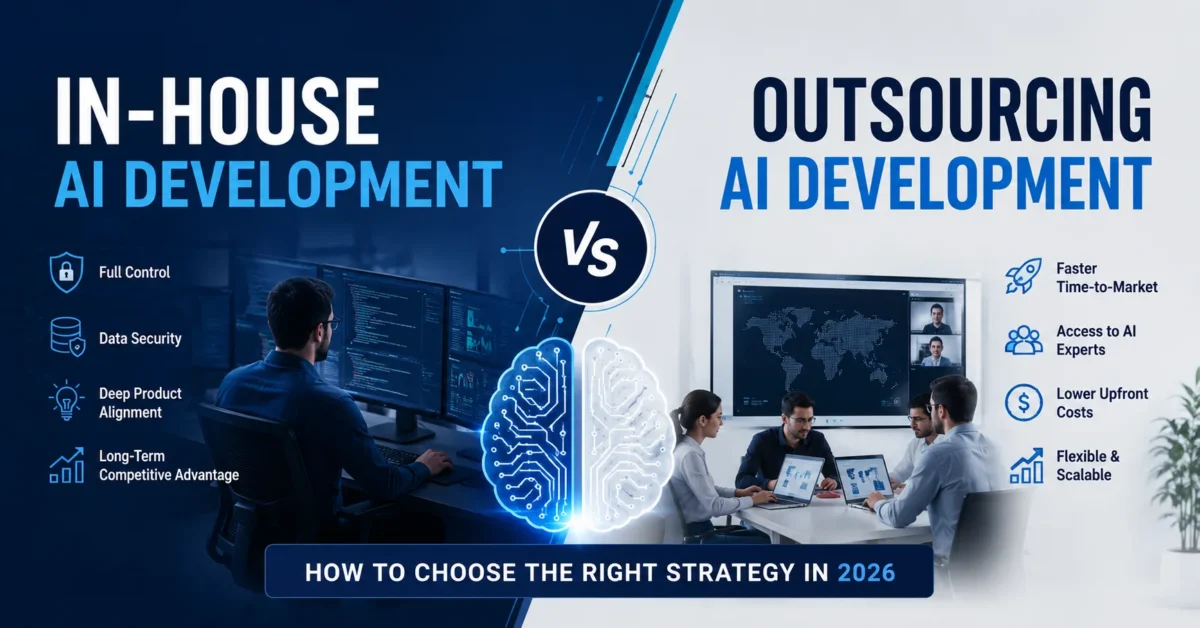
Choosing between building AI in-house or outsourcing depends entirely on how central AI is core product differentiation. For long-term competitive advantage, deep product alignment, and strict data governance, in-house development is the ideal choice. For rapid time-to-market, immediate access to specialized expertise, and lower upfront costs, outsourcing is preferred. In 2026, growth-stage companies increasingly favor a hybrid model: outsource the initial build to launch quickly, then insource capabilities to scale sustainably.
● The right call between in-house and outsourced AI development depends on a company’s goals, budget, data sensitivity, and how central AI is to the business.
● Outsourcing offers speed and cost flexibility, making it an ideal entry point for startups, non-tech organizations, and companies new to AI.
● In-house development is preferred by organizations that need full control over intellectual property, stronger data governance, and AI solutions aligned with strategic goals.
● In 2026, more businesses are adopting a hybrid approach outsourcing first to get something live quickly, then bringing it in-house once the team knows what they’re actually building
Source: grandviewresearch
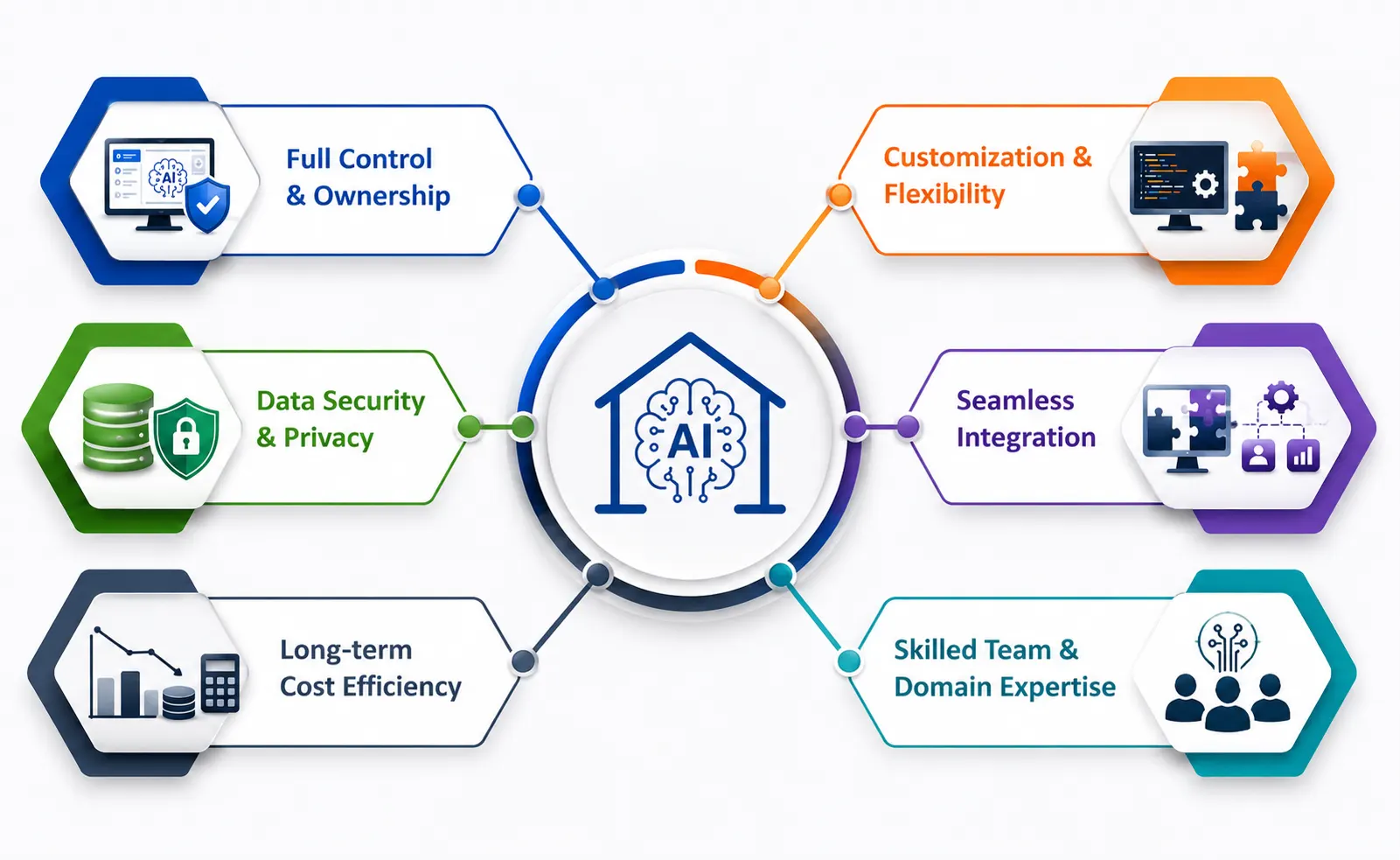
A business should build AI in-house when AI is central to its core product and long-term competitive advantage.
Internal AI teams usually bring together data scientists, ML engineers, software developers, and people who actually know the business domain. When that mix works well, development stays tightly connected to what the organization is actually trying to achieve and that’s where the real competitive edge tends to come from
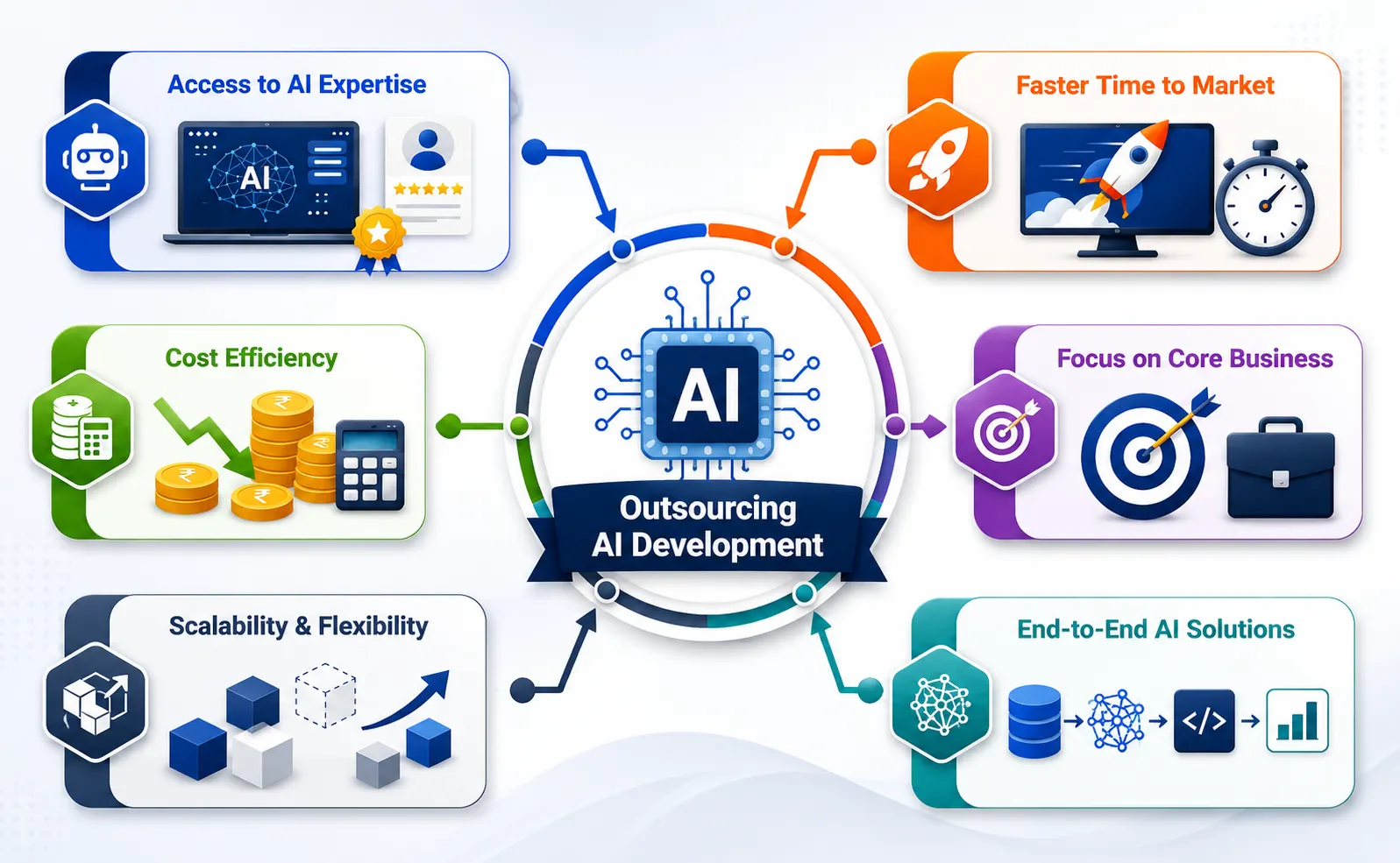
Businesses are outsourcing AI development in 2026 because specialized talent is immediately available without the time and cost of building an internal team.
With professional AI Development Services, to understand how structured AI capabilities are built at scale businesses can deploy their AI solutions rapidly, lower initial expenses, and expand their AI endeavors more effectively while maintaining their focus on their core business.
Rather than hiring and training specialized talent within their own organizations, businesses utilize AI development partners to speed up project completion and upgrade their business operations.
Honestly, this trend isn’t surprising. AI skills are in short supply, and most companies simply can’t hire fast enough to keep up. Outsourcing has shifted from being a cost-cutting move to something closer to a survival strategy for teams trying to stay competitive in 2026.
In-house AI development uses internal teams for total control over intellectual property and data governance, while outsourced AI development leverages external vendors for rapid deployment and flexible initial scaling.
| Factor | In-House AI Development | Outsourced AI Development |
|---|---|---|
| Team Ownership | Full organizational control over development and decision-making | Vendor manages project execution and delivery |
| Talent Access | Limited by internal hiring capabilities and available expertise | Access to specialized AI professionals and domain experts |
| Initial Investment | Higher upfront costs for recruitment, infrastructure, and training | Lower initial investment with flexible engagement models |
| Scalability | Growth depends on internal resources and hiring capacity | Easier to scale teams and resources based on project needs |
| Project Speed | Longer setup and onboarding timelines | Faster deployment through experienced development teams |
| Knowledge Retention | Technical knowledge remains within the organization | Knowledge is shared between the business and external partner |
A business should build AI in-house when the technology serves as its core product differentiator and long-term competitive advantage.
One thing in-house development does really well is keep knowledge inside the company. Vendor projects end, contracts expire, and people move on but when an internal team builds it, that understanding stays with the organization long-term.
All models, datasets and algorithms that are developed in-house are the complete intellectual property of the organisation. Businesses have 100% control over the use, licensing and scaling of the asset.
Sensitive data remains fully contained within the organisation’s own infrastructure, minimising exposure to external data breaches, or compliance failures. It is particularly important for businesses in regulated sectors like healthcare, finance, and legal, where data privacy is essential.
Internal teams have extensive knowledge and understanding of the users, the culture, the product vision, and the long-term product roadmap. This alignment makes sure that all AI solutions developed are aligned with real business requirements and not with the one-size-fits-all approach of an outsider that is not familiar with the organization’s ecosystem.
Every dash, every bug fix, every model iteration that experience accumulates inside the internal team. Vendors take that knowledge with them when the contract ends. An internal team doesn’t. That gap tends to widen in the organization’s favor over time.
Once fully established, internal AI teams deliver updates and new features significantly faster than coordinating with outside vendors. Shorter feedback loops and direct stakeholder access allow faster, more accurate responses to evolving business needs.
A business should outsource AI development when it requires immediate access to specialized skills to deploy a high-quality product without major upfront capital commitments.
● Speed: External teams can deliver a working AI prototype in weeks, not months
● Cost efficiency AI outsourcing cost: A project-scoped, eliminating long-term salary commitments
● Lower risk for first-time AI adopters: Validate the concept before committing to permanent hires
● Scalability: Resource allocation flexes with project needs, not headcount approvals
● Specialized expertise: Vendors bring deep, cross-industry AI experience across NLP, computer vision, generative AI and deep learning.
Discover how Deep Learning Development deliver this specialized capability for outsourced AI projects
The choice relies on five main pillars: product centrality, budget runway, internal talent readiness, data security requirements, and competitive timing.
Factors such as budget, access to skilled talent, project complexity, security requirements, and delivery timelines all play a critical role in this decision. The right approach is the one that aligns with business goals while supporting efficient growth and long-term success.
● AI serves as a core product differentiator and competitive advantage.
● Continuous AI innovation and long-term model evolution are strategic priorities.
● Data governance, compliance, and privacy requirements demand full internal control.
● The organization can support a 12–24 month investment horizon before realizing maximum productivity gains.
● Rapid development of an MVP or proof of concept is a priority.
● AI represents one capability within a broader product or business initiative.
● Budget constraints require a cost-efficient and clearly defined project scope.
● Internal AI talent is limited, making external expertise essential for faster execution.
● External specialists can accelerate development while internal capabilities are built in parallel.
● Decisions between in-house AI development and outsourcing AI development vary across projects and business objectives.
● Long-term ownership and knowledge transfer are important, while immediate delivery timelines remain critical.
The hybrid path exists in outsource to launch, insource to scale is increasingly the dominant AI implementation strategy for growth-stage companies in 2026.
Before choosing an AI development model, businesses should assess budget, internal expertise, data security, AI centrality, and innovation speed. These five factors determine whether in-house, outsourced, or hybrid best fits their goals.
The right AI development model depends on factors such as business goals, available AI expertise, budget, scalability requirements, compliance obligations, and project timelines. Stay ahead with emerging Technology Development built for businesses that cannot afford to fall behind.
Map, 12-month and 36-month financial capacity against both models before committing. Understanding how much does AI development cost upfront prevents costly mid-project pivots.
The most critical factor in in-house vs outsourcing software development decisions. If AI is in a product, build it internally. If AI merely supports a product, outsourcing is the smarter call.
Companies should build an in-house AI team only when they have recurring AI needs, stable funding, and a clear plan for talent retention, not just hiring.
Regulated industries like healthcare, finance, and legal services often cannot share training data with external vendors, making internal development a compliance requirement, not just a preference.
In fast-moving markets where speed determines market share, in house vs outsourcing website development and AI decisions often favor external partners to maintain launch momentum.
This isn’t the kind of decision any business wants to make by default. Whether a company builds internally or outsources, that choice is going to shape the AI development for years and that makes it worth slowing down to think through properly. There is no one-size-fits-all solution, but there is always a right answer for each organization based on its goals, budget, and long-term vision.The companies that actually win with AI aren’t always the ones that spend the most. They’re usually the ones that made smarter calls earlier and adjusted when things didn’t go as planned.
As AI tools grow more accessible and vendor ecosystems more capable, the line between in-house and outsourced development is already blurring in 2026. The trend is shifting toward hybrid models where businesses outsource specific capabilities while building essential AI competencies internally for long-term sustainable growth.
In-house development gives full ownership, control, and knowledge retention, while outsourcing offers faster delivery, flexible costs, and specialized expertise without permanent hiring.
Yes outsourcing gives startups immediate access to specialized talent, reduces upfront costs, and enables faster MVP delivery to validate AI concepts before committing to a permanent team.
It provides instant access to AI expertise, reduces recruitment burden, speeds up delivery, and allows non-tech organizations to adopt AI without building an entirely new internal department.
Higher upfront, but more cost-effective long-term internal teams eliminate recurring vendor fees, retain institutional knowledge, and deliver compounding value as expertise grows.
When AI is core to the product, data privacy restricts external sharing, or recurring needs justify sustained talent investment provided stable funding and a retention plan are in place.
Businesses outsource the initial build for speed, while building internal competencies in parallel balancing agility with long-term control and ownership.
Join over 150,000+ subscribers who get our best digital insights, strategies and tips delivered straight to their inbox.