ChatGPT
 Grok
Grok
 Perplexity AI
ChatGPT
Grok
Perplexity AI
Perplexity AI
ChatGPT
Grok
Perplexity AI
4 min read | By Nishali M | 11 December 2025 |
Vibe Coding 2026 is set to be one of the most revolutionary ways of developing software. It offers an intuitive and collaborative way of building applications, unlike classic programming, which is wholly dependent on the developer to write code. It allows developers to work hand in hand with intelligent systems that can understand their intention and needs and assist them in crafting functional and optimized solutions.
Besides speeding up development, this strategy actually liberates the teams to work on higher-order problems and innovation rather than mundane tasks.
Vibe Coding describes a new paradigm in programming with the help of assistive AI-powered coding tools and generative AI coding tools that support developers in writing, debugging, and optimizing code.This means it is not like traditional coding, where every single line was crafted by a developer; instead, it injects AI’s predictive and generative capabilities into the development workflow.
Developers guideDevelopers guide the AI, and in turn, the AI writes code snippets, suggests improvements, and even automates repetitive tasks. Consequently, a much easier, smoother, and efficient AI-driven programming leaves no stone unturned in accelerating software development while sustaining high-quality standards.
The name “Vibe Coding” came about because of the intuitive, almost organic way a developer interacts with AI in developing code. Traditional coding can feel quite rigid and step-by-step, while Vibe Coding focuses on the flow, rhythm, and “vibe” that a developer is going for in conjunction with the AI.
This means the AI adapts to a developer’s coding style, preferences, and project goals, making this a seamless, personalized experience. The symbiosis between human intent and AI suggestions enables coding to feel and become much more natural, flexible, and enjoyable-thus the term “Vibe Coding.”
Understanding how Vibe Coding works is instrumental in understanding its influence in modern-day software development. Generally, the vibe coding workflow occurs in three sequential stages, at a high level:
Input & Intent Recognition:The developer provides a prompt, partial code, or project specifications, and the AI interprets such input to understand the developer’s intent.
AI Code Generation:Through AI-powered coding engines, the system generates functional code snippets, entire modules, or optimizations. Examples range from repetitive code patterns to boilerplates and even complex algorithms.
Feedback & Refinement:The developers go through the code that was generated by AI, refine it further, or ask AI to recreate the code with certain inputs. Over time, it gets accustomed to the developer’s way of writing and thus becomes better and more relevant.
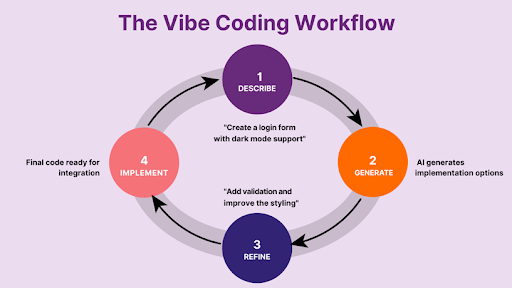
Source: Copilot4devops
| Aspect | Vibe Coding/th> | Traditional Coding |
|---|---|---|
| Pace | With the help of AI generated code and the use of automation, faster development is done. | Writing code manually is a slow, tedious process. Errors depend upon manual debugging and reviews. |
| Mistake Management | The optimized and pre-validated code provided by the AI minimizes the possibility of human errors. | Errors depend upon manual debugging and reviews. |
| Creativity | Developers innovate; AI does the repetition. | Developers handle both routine work and innovation. |
| Learning Curve | Easier for beginners with the help and guidance from AI. | Requires deep knowledge of syntax, frameworks, and best practices. |
| Consistency & Standards | AI maintains consistent coding standards throughout projects. | Depends upon individual developer’s discipline. |
| Adaptability | It adapts to the style of the developer and the project’s needs. | Limited flexibility; completely manual adjustments necessary. |
| Collaboration | Seamless human-AI collaboration | Traditional team collaboration, no integration of AI. |
| Use Cases | Rapid Prototyping, App Development, Debugging, Automation. | Full system development, legacy systems, custom algorithms. |
Implementing Vibe Coding in practice means applying AI-assisted programming and integrating vibe coding tools to improve the efficiency and quality of your development flow, thus creating a more creative workflow in your development process. The idea is to make both developers and AI interact seamlessly.
Choose the Right Tools: Select between vibe coding platforms or genAI coding tools that support your programming languages, frameworks, and project requirements.
Define the Goals of the Project: By structuring prompts, giving partial code, or specifications about what’s desired, AI can generate accurate and relevant code.
Integrate with Existing Workflows: Make sure the AI tool works seamlessly with your IDE, version control, and testing pipelines.
Iterative Collaboration: Consider AI as a collaborator in coding. Scrutinize, refine, and guide the code that emerges, rather than uncritically accepting it. This workflow will be much more instinctive over time as AI remembers your coding style.
Quality & Security Monitoring: Perform code reviews, automated testing, and security checks to ensure that AI-generated code meets performance and compliance requirements.
Vibe Coding revolutionizes the conventional development experience by crafting a more intuitive, collaborative, high-velocity programming workflow. Instead of forcing developers to interact with a static code editor, they work within a dynamic and context-aware environment that adapts to how they work.
Vibe Coding makes the whole coding process more efficient by providing smart suggestions, machine-assisted routines, and live adjustments that eliminate many annoying tasks and facilitate faster delivery.
Through continuous feedback loops, contextual hints, and best-practice guidelines, developers write clean,maintainable code with a smaller number of mistakes.
Having a single platform for co-creation of the unit eliminates misunderstandings in communication among the teams. The visibility of the work done in real-time brings about fast code reviews, easy transfers, and synchronized decision-making.
The environment is not only tailored to the developer’s mental model but also shows dependencies, visualizes logic, and simplifies complex structures—all of which keep the team focused and productive.
Templates, reusable code components, and standardized workflows guarantee consistency across even very big distributed teams.
Assisted setting up: The assisted setting up allows new staff to get quickly to the same level with the use of interactive prompts, learning cues, and contextual explanations.
This frees up more time for developers to be more creative, try things out faster, and push the limits in projects.
Vibe coding has many benefits, it does indeed come with several major challenges that must be navigated carefully by developers and organizations alike. Understanding these challenges is quite vital for the proper implementation of AI-assisted programming and AI-powered coding into live projects.
Reliability:AI-generated code is not perfect; it contains mistakes, inefficiency, and sometimes even unexpected behavior. The developers should go through the result and refine it. Too much dependency on AI, without oversight, could result in some quality issues.
Learning Dependency:Those Source: coders who depend on artificial intelligence too much even for simple coding tasks experience very slow development in manual coding, complicating the solving of difficult problems independently.
Limitations of the tool:Vibe coding environments do not cover all programming languages, frameworks, or specialized algorithms. There might be some who experience difficulty when dealing with extremely tailored or niche-oriented initiatives.
Privacy Issues:There is a possibility that AI technologies inadvertently create security holes or that there are potential dangers related to ownership of the source code and patents. It is up to the organizations to ensure safeguards are in place.
Complexity of Integration:AI will not easily integrate into the current workflow, Continuous Integration/Continuous Deployment pipelines, and team collaboration. To minimize disruption, teams must align AI tools with development practices.
Resource Intensity:Advanced AI-driven vibe coding platforms might be computationally intensive or require subscriptions for which the cost may be beyond the budget of small teams or startups.
The quality of code generated through AI has mostly improved, but it still doesn’t fully match that of experienced developers. AI systems excel at producing routine, repetitive, or well-defined code quickly and with fewer errors in standard patterns. In addition, AI can optimize certain functions and maintain consistency across large projects, which sometimes becomes challenging to do for humans.
AI-generated code still requires human involvement in further reviewing and enhancing if it deals with complicated problem-solving, architectural design, or creative implementation. The key ingredients of a developer’s contribution include contextual understanding, critical thinking, and the ability to foresee long-term consequences-which AI hasn’t mastered yet.
Vibe Coding tool will raise the advantages of AI-assisted programming and AI coding to an exponential level. With numerous vibe coding platforms and genAI coding tools available in 2026, it will pay dividends if one looks at finding the option that suits your workflow, project needs, and team skill set.
Compatibility: First, check whether the tool provides support for your favorite programming languages, frameworks, and development environments. While some platforms specialize in web development, others focus more on app or enterprise software development.
AI Capabilities: Among the features you should consider, intelligent code generation, error detection, optimization suggestions, and automated refactoring are the most significant ones. The main purpose of the AI was to make your day-to-day activities easier, not harder.
Personalization and Learning: If the tool is good enough, it is very likely to learn your coding style from the input you provide. This makes certain that AI-generated code meets the requirements and reduces the number of edits because of the same issue.
Integration: It should be able to integrate with your IDE, version control systems, testing frameworks, and deployment pipelines.
Support & Community: The learning curve will be lower for the platforms that have active support, tutorials, and a very engaged community of developers.
Security: Pay attention to how the tool handles your sensitive code, proprietary algorithms, and project data. Always put security first and never compromise it for the sake of convenience.
VibeOps is a game-changer in the field of artificial intelligence-generated coding. It provides a platform that combines AI-assisted coding with smart workflow automation. It empowers developers to create, test, and optimize code with ease, bringing AI-assisted programming from a concept to concrete reality.
Its strength is its adaptability, the more it learns from developer input and project requirements, the better the code suggestions will be, the less repetition there will be, and the quality will increase. It will make it one of the leaders for the future in vibe coding, where AI doesn’t replace developers but enhances their productivity.
As software development moves toward automation in software development and AI-powered app development, VibeOps is a prime example of what’s possible when AI-powered vibe coding enables teams to deliver projects faster, smarter, and with fewer errors. The platform points to a future wherein coding will be done collaboratively between humans and AI-developed code, shaping the next era in software creation.
Vibe Coding and AI-assisted programming open new avenues for yet another specialization in this field: the AI Engineer. The professional having the utmost responsibility of managing and improving AI-driven development workflows will tailor еnAI coding tools and manage the AI-generated code to be periodically aligned with the project’s objectives, quality standards, and security protocols.
AI engineers integrate the traditional software development process with AI-based coding by applying their expertise in programming, machine learning, and AI model integration. Among their responsibilities could be the adjusting of AI models for particular coding tasks, quality control of the code, and implantation of AI tools in the current development pipeline.
In the near future, AI engineers will be the most crucial staff for the software development and the machine learning-based application development trend which is going to be highly automated in organizations. This role of 2026 will be a turning point for developers and AI to work together closely and the AI knowledge will not only be recognized but also regarded as a must for the upcoming software development generation.
2026 will see the birth of the Era of Vibe Coding wherein AI-assisted programming and AI-powered coding have become the very backbone of software development. Developers are now able to collaborate with AI to code, optimize, and perform the noncreative but necessary tasks of a workflow thereby devoting their time to creativity and innovation.
Vibe Coding platforms and genAI tools are the means to faster project delivery with a very high level of code quality and the possibility of automatic software development all the time. The use of tools such as VibeOps has changed the course of AI-driven coding, transforming it from a mere experiment to a common practice thus making the year 2026 a time when coding becomes a joint, intuitive effort between humans and AI.
Vibe coding relies on AI understanding developer intent, while traditional coding depends on manual syntax and logic writing.
Basic coding knowledge helps, but vibe coding lowers the barrier by letting AI assist with structure, logic, and optimization.
Developers use AI-driven IDEs, conversational coding platforms, and intent-based code generators.
Yes, it scales well because AI systems manage complex workflows, collaboration, and code consistency.
It accelerates development, reduces errors, and enables faster collaboration through intent-based coding.
Join over 150,000+ subscribers who get our best digital insights, strategies and tips delivered straight to their inbox.